Table of Contents
Florida wildlife officials searched critics' private records
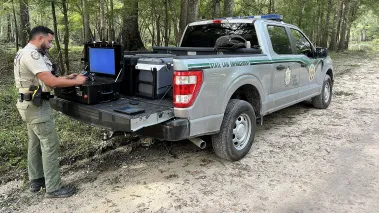
FWC / Wikimedia Commons (public domain)
A Florida Fish and Wildlife Conservation Commission officer readies a drone at the back of a law enforcement vehicle, August 2024.
Jim Watt had become a familiar face at Florida wildlife meetings. A retired turtle farmer, he was often there to raise concerns about the use of pesticides. These public meetings gave citizens a place to do exactly that. By his account, Watt never once raised his voice.
But in July, The Orlando Sentinel reported that Florida Fish and Wildlife Conservation officers have for years used driver’s license records to monitor environmental activists who spoke up at public meetings. The agency says it began using the database to investigate critics after staff received threats. It pulled information for more than 20 people, accessing Watt’s personal information 34 times, even though the agency later said he was never under criminal investigation.
When Watt learned that the agency had been quietly pulling his records, he became afraid to return to the meetings. “When I drive down the road and I see a game warden truck pull up near me,” he says, “I’ve never been afraid of law enforcement in my life, but I am now. I’m afraid.”
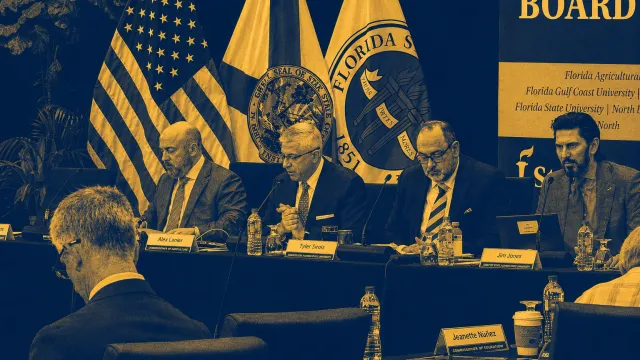
Florida wants colleges out of politics, but its plan has a loophole
Florida wants public colleges out of politics. But a loophole in its neutrality plan could give administrators a new license to speak out.
The database FWC officials accessed — Florida’s Driver and Vehicle Information Database, or DAVID — is no ordinary system. It’s a restricted government database containing addresses, driver’s license numbers, dates of birth, Social Security numbers, vehicle information, and other sensitive details. In many cases, the reason given for the searches was reportedly “Criminal Investigation.”
The FWC denies misusing or weaponizing its law-enforcement authority, saying the searches were a public-safety measure prompted by threats against commissioners and employees, including over Florida’s black bear hunt. The agency cited a protest outside a commissioner’s business as well as alleged doxxing, and released a collection of hostile social media posts, including one in which the poster said whoever proposed the hunt “should be shot.”
Government officials can investigate credible threats of violence — true threats are not protected by the First Amendment. But angry rhetoric, violent imagery, and ugly political hyperbole do not automatically cross that line. Whether any of the examples the FWC released crossed that line is far from clear. Context matters.
But even if they did, records show that many of the people whose records the agency pulled had not written any of the posts it cited to justify those searches. Instead, many searches took place after someone simply criticized the FWC online or spoke up at a public forum, and the agency had offered no evidence that it ever suspected some of these people were a threat.
Public meetings exist so citizens can question, challenge, and sometimes anger the officials who exercise power over them. That process breaks down when people have to wonder whether criticism will invite government scrutiny.
This is not the FWC’s only recent free-speech controversy either. FIRE recently criticized a broad FWC social media policy that restricted employees’ speech on their personal accounts. The FWC also paid $485,000 to settle a lawsuit filed by a former biologist who was fired for reposting a meme on her personal account that claimed Charlie Kirk wouldn’t care about children being shot. These episodes involve different facts, but they sharpen the concern raised here: whether FWC treats criticism as something to tolerate — or something to investigate.
The FWC says Floridians should be able to speak at its meetings and disagree with its commissioners without paying a personal price. Yet Watt learned that, after repeatedly doing just that, agency officials had accessed his personal information 34 times. The FWC has not shown that he threatened anyone or was suspected of a crime. When a law-enforcement agency searches the records of its critics without a clear public-safety justification, it blurs the line between a dissenter and a suspect — and makes speaking up feel risky.
The damage does not stop with the people whose names were searched. Public meetings exist so citizens can question, challenge, and sometimes anger the officials who exercise power over them. That process breaks down when people have to wonder whether criticism will invite government scrutiny. Watt says he is now afraid to return to meetings he once regularly attended and that fear itself is a price. Floridians should not have to choose between criticizing their government and wondering whether their government is quietly looking into them.
FIRE is a nonpartisan, nonprofit organization dedicated to defending and sustaining the individual rights of all Americans to free speech and free thought — the most essential qualities of liberty. Support FIRE's advocacy by making a free speech donation today.
Recent Articles
Get the latest free speech news and analysis from FIRE.
After a congressman challenged a student reporter’s right to record, here’s what journalists should know
Restoring Title IX kangaroo courts is no solution to the ‘Cornell 7’ sexual assault controversy

A UK teen mocked a local politician. Then the police showed up.