Table of Contents
VICTORY: Iowa judge dismisses Trump’s lawsuit against pollster J. Ann Selzer
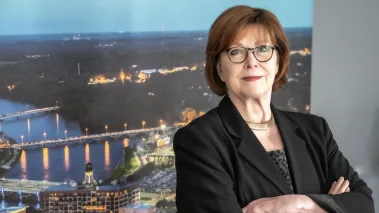
Jenny Condon Photography
DES MOINES, Iowa, Sept. 23, 2026 — An Iowa state court on Wednesday dismissed President Donald Trump’s frivolous lawsuit against veteran pollster J. Ann Selzer and the Des Moines Register newspaper.
The decision handed down by Judge Scott J. Beattie is the latest in a string of setbacks in multiple legal actions brought by Trump and his allies claiming “fake news” in a groundless pursuit of Selzer.
“At its core, the plaintiffs’ petition seeks to stretch both Iowa statutory and common law beyond their current bounds, turning speech that enjoys the highest category of First Amendment protection into a liability,” Beattie wrote in his ruling.
Selzer is represented by the Foundation for Individual Rights and Expression.
“We’re pleased that the court recognized what we’ve said all along: This lawsuit was laughable from the beginning and never should have been brought,” said FIRE Chief Counsel Bob Corn-Revere, who led Selzer’s defense. “The First Amendment does not allow anyone in government, least of all the president, to punish people under the banner of ‘fake news.’ That may work for him as a campaign slogan, but it is not a thing in the law.”
The lawsuit stemmed from a poll Selzer published before the 2024 presidential election that predicted Vice President Kamala Harris leading by three points in Iowa. The suit asserted claims, including under Iowa’s Consumer Fraud Act, alleging that Selzer’s poll, which missed the final result by a wide margin, constituted “fake news” and “fraud.”
Selzer pushed back. FIRE explained that commentary about a political election is core protected speech. “Fake news” is a political buzzword, not a legal cause of action. And “fraud” is a defined legal concept: intentionally lying to convince someone to part with something of value.
But let’s be clear about one thing: This was never about “consumer fraud.” Nor was it about winning in court. Trump’s lawsuit was about intimidating perceived critics into silence by making them waste time and money on lawyers to defend perfectly legal speech. It’s called a “SLAPP” suit — a Strategic Lawsuit Against Public Participation. Such tactical claims are filed purely for the purpose of imposing punishing litigation costs on perceived opponents, not because they have any merit or stand any chance of success. In other words, the lawsuit is the punishment. And it’s part of a worrying trend of activists and officials using consumer fraud lawsuits to target political speech they don’t like.
Iowa has since passed an anti-SLAPP statute, which makes the loser who files a frivolous suit pay for the defendant’s attorneys’ fees, but Trump purposefully filed this lawsuit just hours before it took effect.
But Trump didn’t count on FIRE. To offset the costs, FIRE is representing Selzer pro bono.
A copycat class-action lawsuit based on the same flimsy legal arguments was dismissed by a federal district court in November. In addition to Trump, other plaintiffs include Rep. Mariannette Miller-Meeks and former state Sen. Brad Zaun, who was appointed by Trump to serve in the Small Business Administration.
Since the poll’s release, Selzer acknowledged the margin between her poll and the eventual outcome and did what good pollsters do: She explained her methodology and publicly shared the poll’s crosstabs (results reported out by demographic and attitudinal subgroups), its questionnaire (with demographic information and weighted and unweighted responses), and her theories on the results, inviting others to offer theirs in turn.
“Polling is a social science, not clairvoyance, and no responsible pollster can guarantee an election outcome,” Selzer said. “What we can guarantee is that we will follow the data wherever it leads, even when the results are uncomfortable or unexpected. I am grateful that Judge Beattie's ruling recognizes these principles and reaffirms the fundamental freedom to pursue and publish the truth without political interference.”
The Foundation for Individual Rights and Expression (FIRE) is a nonpartisan, nonprofit organization dedicated to defending and sustaining the individual rights of all Americans to free speech and free thought — the most essential qualities of liberty. FIRE recognizes that colleges and universities play a vital role in preserving free thought within a free society. To this end, we place a special emphasis on defending the individual rights of students and faculty members on our nation’s campuses, including freedom of speech, freedom of association, due process, legal equality, religious liberty, and sanctity of conscience.
CONTACT:
Karl de Vries, director of media relations, FIRE: 215-717-3473; media@thefire.org
Recent Articles
Get the latest free speech news and analysis from FIRE.
VICTORY: New Jersey drops complaint against school board member targeted for asking constituents about taxes

FIRE sues Los Angeles City Council over policy banning certain words during public comment

It was never just going to be about keeping kids off social media