Table of Contents
FIRE POLL: Americans trust parents — not government — to oversee kids’ social media
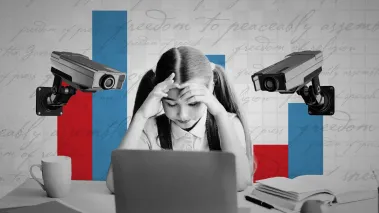
PHILADELPHIA, May 7, 2026 — A new poll finds that if Americans want anyone to watch over children’s browsing habits, it’s Mom and Dad, not Big Brother.
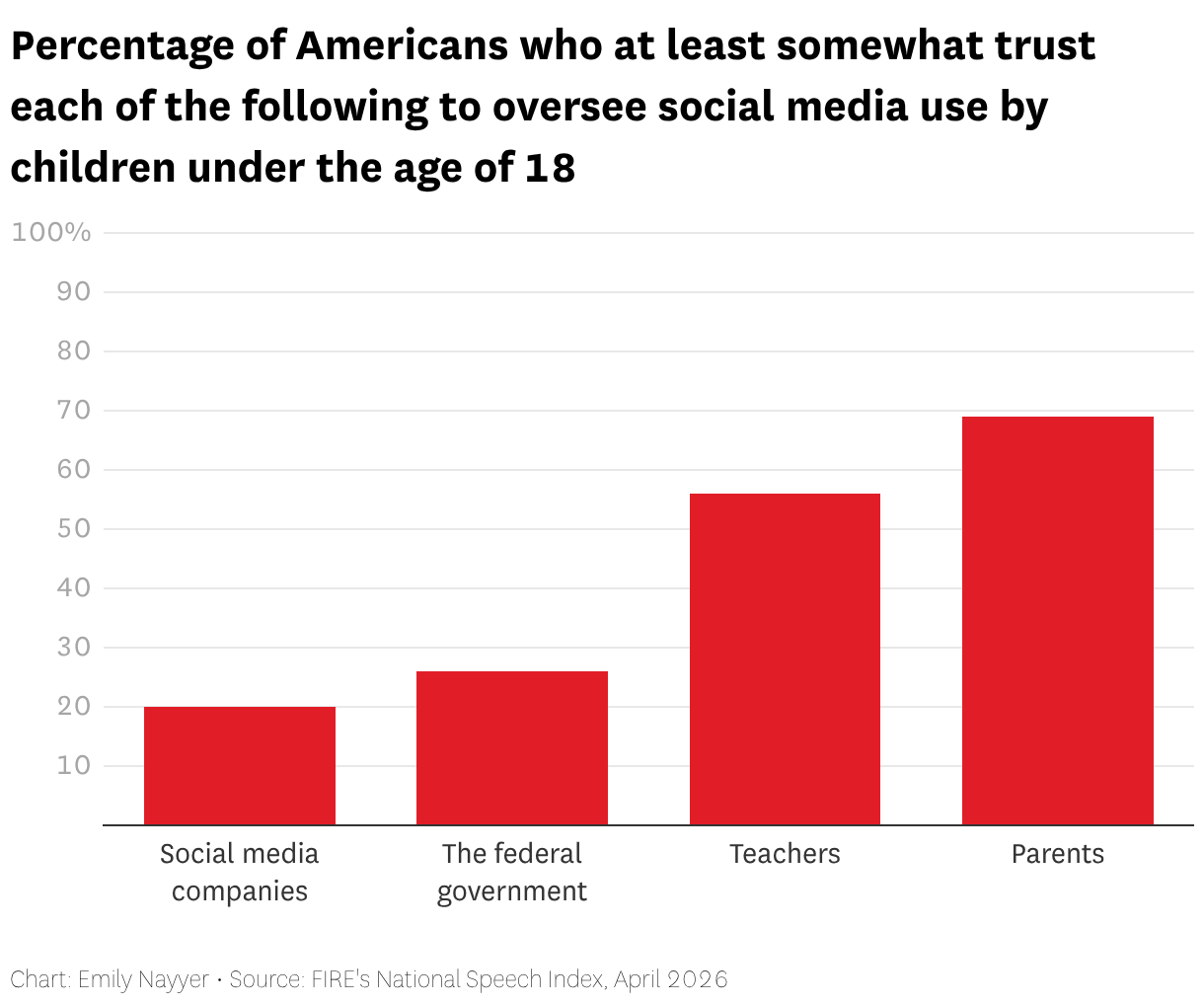
The National Speech Index is a quarterly poll from the Foundation for Individual Rights and Expression designed to track Americans’ changing attitudes and beliefs about free speech. Amid an ongoing debate over proposals to ban social media use by children, the April 2026 edition of the NSI asked respondents who they trusted to oversee social media use by children.
Social media companies were viewed with the most distrust, with 79% of Americans expressing low trust, including a majority (55%) who said they had no trust at all. Not far behind was the federal government, with 73% of Americans expressing little or no trust. Far more trusted were parents — who 69% of Americans trusted at least somewhat — and teachers — who 56% trusted at least somewhat.
“The American people don’t trust tech companies when it comes to social media use by minors, but wisely, they don’t trust the federal government, either,” said FIRE Vice President of Research Angela Erickson. “Ultimately, decisions about children’s online activity are best left to parents, not politicians.”
The April NSI also asked Americans about varying forms of "jawboning," a practice in which the government attempts to get around the First Amendment by pressuring third parties to remove or punish disfavored speech. The Supreme Court has held, for example, that if a state can’t ban a book without violating the First Amendment, it also can’t intimidate bookstores into not carrying that book.
Americans expressed a high level of concern about the federal government pressuring tech companies for access to their products so they can be used for mass surveillance, with 77% at least somewhat concerned. Americans were equally concerned about the federal government pressuring media organizations to report news about foreign affairs in a favorable way (72%), pressuring social media companies to suppress the posting of certain viewpoints (75%), and pressuring platforms to remove videos because of the viewpoints expressed (74%).

FIRE also asked respondents about their comfort level with common forms of protest tactics to counteract a speech in their community. Large majorities of Americans rejected overtly violent censorship tactics, with 82% saying it is never acceptable to use physical violence to stop a speaker and 67% saying it is never acceptable to block entry to the event.
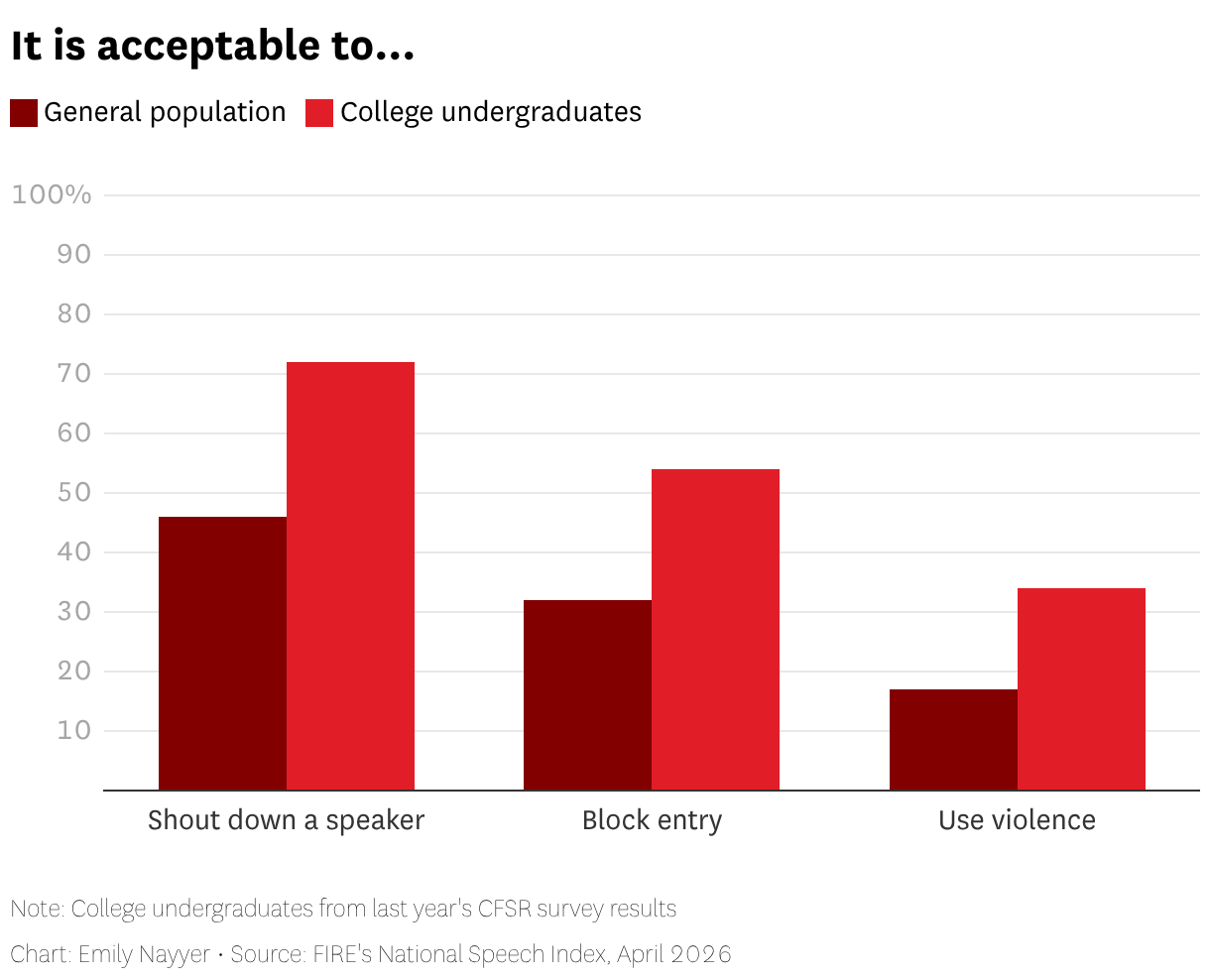
Slightly more than half of Americans (53%) said it was never acceptable to shout down a speaker, and slightly less than half said it was never acceptable to heckle the speaker before they began speaking. Meanwhile, 76% of Americans say it is always or sometimes acceptable to hold a sign silently during a speech, and 86% say it is always or sometimes acceptable to protest outside the event.
Notably, the average American’s disapproval of censorship tactics is significantly higher than the disapproval from college students when FIRE posed a similar question in the College Free Speech Rankings. College students are 25 points more likely to say shouting down a speaker is at least rarely acceptable, 22 points more likely to say blocking entry is at least rarely acceptable, and 17 points more likely to say violence is at least rarely acceptable to stop a speaker.
“Taken together, these results should be a wake-up call for educators across the country,” said FIRE Chief Researcher Sean Stevens. “Colleges and universities are supposed to prepare students for civic life and teach them how to engage with ideas they disagree with. Clearly, far too many students aren’t getting the education they need.”
The National Speech Index is a quarterly poll designed by FIRE and conducted by the Dartmouth Polarization Research Lab to capture Americans’ views on freedom of speech and the First Amendment, and to track how Americans’ views change over time. The April 2026 National Speech Index sampled 1,000 Americans and was conducted from April 9, 2026 through April 17, 2026. The survey’s margin of error is +/- 3%.
The Foundation for Individual Rights and Expression (FIRE) is a nonpartisan, nonprofit organization dedicated to defending and sustaining the individual rights of all Americans to free speech and free thought — the most essential qualities of liberty. FIRE educates Americans about the importance of these inalienable rights, promotes a culture of respect for these rights, and provides the means to preserve them.
The Polarization Research Lab (PRL) is a nonpartisan collaboration between faculty at Dartmouth College, Stanford University and the University of Pennsylvania. Its mission is to monitor and understand the causes and consequences of partisan animosity, support for democratic norm violations, and support for partisan violence in the American Public. With open and transparent data, it provides an objective assessment of the health of American democracy.
CONTACT:
Alex Griswold, Communications Campaign Manager, FIRE: 215-717-3473; media@fire.org
Recent Articles
Get the latest free speech news and analysis from FIRE.
After a congressman challenged a student reporter’s right to record, here’s what journalists should know
Restoring Title IX kangaroo courts is no solution to the ‘Cornell 7’ sexual assault controversy
A UK teen mocked a local politician. Then the police showed up.