Table of Contents
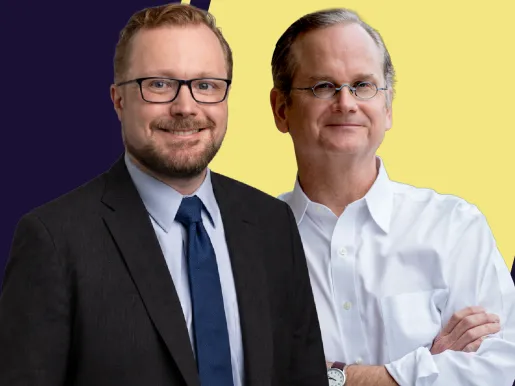
So to Speak Podcast Transcript: Debating Super PACs and campaign finance w/ Larry Lessig and Paul Sherman
Note: This is an unedited rush transcript. Please check any quotations against the audio recording.
Larry Lessig: But if you’d said to Madison, “We’re gonna have a system where they’re dependent on the rich more than the poor in order to get to the House of Representatives. And constitutionally, that’s required. Nothing we can do about that.” Would Madison have said, “Yeah, that’s my First Amendment?” Hell no.
Paul Sherman: See, but I think, again, that’s misrepresenting what Federalist 52 is saying when it says, “dependent on the people alone.” Dependent on the votes of the people alone. But what we’re doing with campaign finance is not regulating votes – we are regulating the information environment in which voters can reach decisions about who should represent them.
Male Speaker: Somewhere I read of the freedom of speech.
Nico Perrino: You’re listening to So to Speak: The Free Speech Podcast. Brought to you by FIRE, the Foundation for Individual Rights and Expression. Welcome back to So to Speak, the free speech podcast where we take an uncensored look at the world of free expression through the law, philosophy, and stories that define your right to free speech. I’m your host, Nico Perrino. In 2010, two landmark decisions transformed American campaign finance law. The first was Citizens United v. the Federal Election Commission. And the second was Speech Now v. FEC. Together, they cleared the way for corporations and so-called super PACs to raise and spend unlimited sums of money in elections.
What followed was a new era in American politics where individuals, corporations, and industries increasingly spent more and more money to influence campaigns and public opinion. Just last week, $33 million was spent in a Kentucky Republican primary between Representative Thomas Massie and his Trump-backed challenger, Ed Gallrein, making it the most expensive House primary race ever. This influx of spending has pushed some Americans to ask, “Is there too much money in politics?”
Supporters of the current system say no. In their view, money enables speech. And the First Amendment does not allow the government to restrict political speech simply because it’s influential. However, critics argue that the system has concentrated political power in the hands of a wealthy few. Now, a case out of Maine could force courts to revisit one of the core assumptions behind the modern super PAC era. Today we’re joined by two guests who have spent years on opposite sides of this debate – or so I think; we’ll see. Larry Lessig is a Harvard Law professor, the founder of the nonprofit Equal Citizens, and one of the country’s leading advocates for campaign finance. Larry, welcome onto the show.
Larry Lessig: Thanks for having me.
Nico Perrino: And Paul Sherman here to my left is a senior attorney at the Institute for Justice and served as co-counsel in speechnow.org, the case that helped create the modern super PAC framework. Paul, welcome onto the show.
Paul Sherman: My pleasure.
Nico Perrino: Both first time guests. First time guests. Larry, I wanna start with you. What is your interest in campaign finance issues and issues of political speech and spending more generally? Where did this originate?
Larry Lessig: Well, it was literally almost 20 years ago. I had been doing work on the internet on copyright, and a friend of mine, Aaron Schwartz, came and said, “Why do you think you’re ever gonna make any progress on the issues I was working on, so long as we have this deeply corrupt system for funding campaigns?” And I said, “It’s not my field, Aaron.” And he said, “You mean, as an academic?” And I said, “Yeah. I do copyright. I do internet policy. I don’t do campaign finance reform.” And he said, “Well, what about as a citizen?” He said, “Your field as a citizen.” And I realized he had kind of cornered me.
Because it was true, I didn’t think there was any substantial reform we were gonna see in those esoteric areas and fundamental areas like climate change. Or any other important area of policy given the corrupting influence of money inside of our political system. So, I promised him that night I would take up the fight. We lost Aaron to suicide.
Nico Perrino: I was gonna ask, is this that same Aaron Schwartz?
Larry Lessig: Yeah, it’s the same Aaron Schwartz. We lost him to suicide. And when we lost him to suicide, I said I was gonna work on this until we had a substantial victory. So, that’s what I’ve been doing for 20 years.
Nico Perrino: So, you haven’t had your substantial victory yet?
Larry Lessig: We’re about to. But not yet.
Nico Perrino: We’ll discuss that. Paul, what about you?
Paul Sherman: So, my background in campaign finance started when I went to grad school. I have a master’s degree in political campaigning. I think, like most people at the time – this was right around when the McCain-Feingold law was being debated and passed.
Nico Perrino: And what year was that?
Paul Sherman: Oh, I’m sorry, this was around 2000, 2001. I think, like most people, campaign finance regulation struck me as very common sense. I did see corruption in politics – I thought politicians were crooked. And campaign finance laws seemed to me to be a sensible way to address those problems. I had a professor at the University of Florida who challenged my views on that.
And the more I read about it, and the more I studied variation in campaign finance at the state level, I became much more skeptical. Eventually, I went to law school. Actually, the final exam question in my campaign finance class was, “Are contribution limits to super PACs constitutional or not?” I argued they were unconstitutional. I got an A- in the class. I feel like, in retrospect, maybe that should be adjusted.
Larry Lessig: Up or down?
Paul Sherman: We’ll see, I guess. And then, eventually, I went to work for a group then called the Center for Competitive Politics, now called the Institute for Free Speech. And at the time, they were developing the Speech Now case with the Institute for Justice, where I work now.
Nico Perrino: So, 2010 seemed to be a seminal year in the campaign finance debate. We got that Citizens United decision, of course, and we also got the speechnow.org decision, which came out of the DC circuit. Whereas the Citizens United case came out of the Supreme Court. Can you guys provide me with a little bit of background – and our listeners, of course – with a little bit of background around these two cases and their significance? Maybe Larry I’ll start with you and the Citizens United case, and then I’ll go to you, Paul, on the Speech Now case. Because you were co-counsel in it.
Larry Lessig: Yeah. Citizens United, of course, is one of the most famous Supreme Court cases.
Nico Perrino: Or infamous, depending on how you look at it.
Larry Lessig: Exactly. And it is constantly pointed to as the reason we have super PACs. And I kind of feel bad for the lawyers in Speech Now, ‘cause I think that credit doesn’t belong to Citizens United’s lawyers, it belongs to Speech Now’s lawyers. Because it wasn’t Citizens United that created super PACs. Citizens United addressed the question whether a corporation or union or a political action committee could spend unlimited amounts of money independently of a campaign. And it really was just an extension of a decision made in 1976 – Buckley v. Valeo – where the very same question was raised about rich people. Could you limit the amounts that rich people spend independently of a campaign?
And what the court said in Buckley was no, you can’t limit the amount they’re gonna spend because the only justification for regulating political speech was to avoid the risk of corruption, they said – quid pro quo corruption. And if the money is independent, if there’s no coordination between the spending and the campaign, then, as Justice Kennedy would say on Citizens United, by definition there’s no risk of quid pro quo corruption.
Nico Perrino: There’s no risk of “this for that” corruption.
Larry Lessig: Yeah, there’s no –
Nico Perrino: If you give me this, I will give you that.
Larry Lessig: Yeah. Because there’s no coordination. Now, people forget the other side of that, which Buckley made very clear. If there is coordination, if you purport to spend this money independently but it turns out there was a coordination, then that spending converts into a contribution to a campaign. So, if you spend $10 million purportedly independently, but the FEC comes along and says, “This was not independent. You guys were coordinating.” That $10 million becomes a contribution to the campaign, which is obviously way beyond the limits you’re allowed to contribute to a campaign. So, you could be, in principle, criminally exposed because of that contribution.
So, there are two sides to this. It is independent, and as long as it’s really independent – meaning not coordinated – you can’t limit it. Because you have no justification for limiting it, except the risk of corruption. Now, I think, as a matter of logic – the case was not about factually what in fact happens in the world. It was a matter of logic. Kennedy said, by definition, “I think as a matter of logic it’s fine. Yeah, of course. If there’s no risk of corruption and the only basis that you have for regulating is the risk of corruption, then you can’t limit the expenditures.” And that’s all Citizens United established.
Nico Perrino: And how do you determine whether any coordination takes place? I mean, you could theoretically be a pretty savvy campaign and just put up a website that says, “These are the messages we’re trying to send.” And then, these independent groups – or corporations in this case – look at that and say, “Oh, that’s what the candidate wants us to say.” And says it.
Larry Lessig: Yeah. So, it turns out to be –
Nico Perrino: But there’s no perhaps corruption there.
Larry Lessig: There’s no quid pro quo, necessarily.
Nico Perrino: But there is coordination, perhaps. Or the suggestion. It’s a way around, perhaps, the coordination area.
Larry Lessig: Yeah. The point is, the law has a pretty complicated set of understandings about what coordination is gonna be. And the critical, practical thing to think about is, if you’re running, for example, a super PACs, you can direct your staff about what your staff is supposed to do to avoid any risk of corruption. Like, “Here are the things you can’t be doing. Here are the people you can’t be talking to. Here are the things you can’t be talking about.” And as long as the staff obeys that, then the political action committee is not risking exposure from their expenditures being converted into a contribution. So, it’s relatively straightforward for them to be able to tell.
Nico Perrino: And the FEC polices all this?
Larry Lessig: In theory. I mean, if we had an FEC. But yeah.
Nico Perrino: And that’s the Federal Election Commission.
Larry Lessig: Yeah. That’s their job.
Nico Perrino: And Paul, my understanding is that there’s a lot of confusion around what the Citizens United case was really about. It was about a nonprofit corporation that wanted to make a movie about Hillary Clinton, right? And they wanted to release that movie within a certain period before the election?
Paul Sherman: Yeah, so, the Citizens United case – actually, a very interesting and underappreciated fact about it is that it didn’t start as a case about the prohibition on corporate spending at all. It started purely as a case about disclosure of what are called electioneering communications.
Nico Perrino: What’s that mean, disclosure?
Paul Sherman: Oh, so, disclosure is when you are required to report to the government, and the government makes publicly available the name, identity, occupation, employer, and amount of money contributed by individuals or groups to certain types of political speakers or campaigns. So, under federal law, if you give more than $200.00 to a federal candidate’s campaign, your name, address, occupation, and employer goes on the FEC’s website. And then, that’s aggregated on websites like Open Secrets and things like that. To deal with the fact that corporations had long been prohibited from making independent expenditures, corporations of course were coming right up to the line.
And they were running ads that did not meet the definition of independent expenditure, because they didn’t explicitly say “vote for” or “vote against.” So, in the McCain-Feingold law from 2001, they created this concept of electioneering communications, which were communications that mentioned candidates within a certain closed period of time before the election. And corporations were prohibited from funding those. And people who did fund them had to disclose the donations that funded them.
When the Citizens United case was filed, it was purely filed about the disclosure part of that. But actually, as it happened, the case evolved, Citizens United have the opportunity to run this documentary called Hillary: The Movie. They had been planning to run it just in movie theaters, but they got the chance to do it on video on demand. And because cable television fell within the scope of the electioneering communications limit, that raised this question of whether the movie could be banned from cable TV because it was funded in part by corporate contributions to Citizens United.
Nico Perrino: And was the movie gonna say anything about whether one should vote for Hillary Clinton or not? Or was it just a movie about her career?
Paul Sherman: Well, so, I think that probably depends on who you ask. The way it would’ve been characterized, I think, by Citizens United is this is a purely factual documentary about kind of the qualities of Hillary Clinton. I think that’s kind of dubious. Even if no one was saying “vote for” or “vote against,” probably people would’ve seen the documentary as what the Supreme Court referred to as the functional equivalent of express advocacy.
So, even though it doesn’t have the words, everyone who’s viewing it will see this as vote against Hillary Clinton, vote for her opponent. And the Supreme Court, for purposes of deciding the case, assumed that’s what it was. It said, “We’re going to assume it’s express advocacy.” And then, it reached the conclusion that Larry said – you still can’t ban expenditures for this type of political advocacy just because the money comes from a corporation.
Nico Perrino: There was a very famous moment in the oral argument, right? Where one of the Justices asked the advocate representing the government whether this would also extend to books. So, if this Hillary: The Movie was turned into Hillary: The Book, would that be express advocacy? And that seemed to kind of doom the case, right?
Paul Sherman: Yeah. So, this was also an unusual case ‘cause it was argued twice, which almost never happens. Well, I mean, there’s some speculation about that. We don’t know exactly why. But the first time it was argued, Assistant Solicitor General Malcolm Stuart argued for the government, trying to defend the restrictions. And he was asked this question, “Well, what if it was a book funded by a union or a corporation?
Nico Perrino: Yeah, nonprofits, unions are all corporations.
Paul Sherman: Right. The whole book is factual discussion, and then at the end, it says vote for or vote against this candidate – could you ban that book? And Stuart kind of hemmed and hawed and said the restriction doesn’t reach that. But when he was nailed down, he said, “If the law were written to reach that kind of medium of communication, then yes, you could ban that book.” And there was kind of a gasp in the courtroom. Justice Souter, who was no opponent of campaign finance restrictions, seemed very taken aback. And then, for reasons that there’s been speculation about, we don’t quite know, the case was held over and re-argued the following term. Now Justice Elena Kagan –
Nico Perrino: Yeah, I was gonna say. Yeah.
Paul Sherman: Was actually the solicitor general who argued the case. They said that they had reconsidered their view on that point. Souter had, by this time, left the court. And the court didn’t buy it. It said that the same logic would apply to other types of communications. That really was, I think, the rhetorical moment that lost them the case.
Nico Perrino: Yeah. And so, I’m assuming you support the outcome in this decision?
Paul Sherman: I do support the outcome in Citizens United, that is correct.
Nico Perrino: What about you, Larry?
Larry Lessig: Well, I think under the reasoning – it says the only reason you can limit speech is the risk of quid pro quo corruption – it follows as a matter of logic. I think that’s true. I mean, it’s not my conception of what the First Amendment should be – in fact, I’m an originalist about the First Amendment. And I think on the original meaning of the First Amendment, you would have no ability of the court to be restricting campaign finance in this context.
So, I think this is completely baseless field of jurisprudence. But I just circulated a piece titled If Roe, then Buckey. I mean, there’s no basis for – under an originalist theory – the ongoing jurisprudence of campaign finance. But assuming this is the framework, yeah, I think Citizens United is a true application of that framework.
Paul Sherman: Well, and if I can just jump in, I think that’s an excellent point. Because one of the – I mean, the central tension in campaign finance law, for the last 50 years, has always been Buckley. Buckley is a decision that really split the baby. In the wake of Watergate, Congress enacts the Federal Election Campaign Act.
For the first time, there are individual limits on political contributions at the federal level, and political expenditures. It goes to the Supreme Court, and the Supreme Court divides the analysis, and it strikes down the expenditure limits. It upholds the contribution limits. And basically, no one in 50 years has ever been satisfied by this. I think Eugene Ballock is the only person I’ve seen who suggested that that was a reasonable way to divide it.
Nico Perrino: Eugene Ballock, satisfied?
Paul Sherman: But if you’re on the reform side, you think that the expenditure limit holding was wrong. If you’re on the – I don’t wanna use too loaded a term, but let’s say the free speech side – you think that the contribution limit holding was wrong. And all of these difficulties that we have in line drawing essentially arise out of this division.
Larry Lessig: Yeah. But I mean, Justice Thomas has been trying to get New York Times v. Sullivan struck down.
Nico Perrino: And so, is Alan Dershowitz – he’s got a petition in front of the Supreme Court, right? Your former colleague, I assume.
Larry Lessig: Right. And when he’s doing this, he keeps on telling us that New York Times v. Sullivan was policy driven decision masquerading as constitutional law. And when I first read that, I thought, have you read Buckley v. Valeo, Justice? I mean, this is a 144-page per curiam opinion. Not once does it try to explain to us what the original meaning of the First Amendment was and why this follows from the original meaning of the First Amendment.
Instead, they divine this device, this corruption device, which they think is the true measure of whether you can have campaign finance reform laws or not. And so, again, under that principle, I think Citizens United follows. I don’t think there’s any problems with Citizens United. What doesn’t follow is Speech Now. What doesn’t follow is that even though you can’t have limitations on expenditures, it doesn’t follow as a matter of logic – under the reasoning of Citizens United and Buckley – that you can’t have limitations on contributions.
Nico Perrino: Well, that’s a good segue to turn now to the Speech Now case, which you were co-counsel in, Paul. What was the purpose of this case, and was it, as Larry says, to strike down the contribution limits to these independent political action committees that aren’t coordinating with a campaign?
Paul Sherman: Yeah. So, the purpose of Speech Now was to target a very specific what we thought was illogic that had persisted since the decision in Buckley v. Valeo. So, among the limits that Buckley imposed was a limit on individual expenditures. So, a wealthy person could not spend more than…I don’t know if it was $5,000.00 or who knows. All of the numbers have changed over the years. Wealthy people were capped in how much they could spend advocating the defeat or election of federal candidates.
Nico Perrino: And that’s independently of a contribution?
Paul Sherman: Independent. ‘Cause, as Larry said, if it’s not independent, it’s a contribution. Sure, that’s the way it’s treated. So, the Supreme Court struck that down. So, a billionaire can spend a billion dollars on political advocacy. But if you and I and Larry were to get together and want to do the same thing, we would be limited to $5,000.00 a piece, because at that point, when you have more than one person, you’re a pack. A political committee. And you’re subject to contribution limits. And that just didn’t make sense to us. If it’s fine for Bill Gates to spend a billion dollars, it should be fine for us to get together and throw in $10,000.00 a piece or more.
That was the way we framed it. And we developed the case in 2008 – actually before Citizens United was about the corporate expenditures – and the case was structured in such a way that it would avoid the issues that were directly related to corporations. So, Speech Now is chartered to not allow it to accept the corporate contributions. It was structured as an unincorporated nonprofit association in the District of Columbia. And our argument was really based on these earlier decisions.
There’s a case from the 1980s, Citizens Against Rent Control v. City of Berkley, which was about contribution limits to ballot issue committees. That was the structure of the case. And then, a week before oral argument at the DC circuit, Citizens United comes down. And then, the first question that Judge Sentelle asked my colleague, Steve Simpson, was, “What do you have to tell us that Justice Kennedy didn’t resolve last week?” And Steve said, “Well, not much, Your Honor.” And it was kind of a forgone conclusion at that point.
Nico Perrino: But Larry, you say that the logic of Citizens United shouldn’t have reached the Speech Now case at all, right?
Larry Lessig: Yes.
Nico Perrino: And that the first question probably shouldn’t have been about Citizens United, ‘cause it was not related. How so?
Larry Lessig: I mean, I’ve spent a lot of time reading that argument. It’s quite an extraordinary argument. First of all –
Nico Perrino: This is the transcript from the oral?
Larry Lessig: Transcript from the oral argument. Because first of all, I mean, your side basically got no chance to address the corruption issue. They spent most of the argument trying to deal with the disclosure question, which went on and on and on. And then, when the other side got up, they got to get to the corruption issue. But I think the FEC’s lawyer, or the government’s lawyer, made a really fundamental mistake. Because the core question Judge Sentelle and Judge Ginsberg were trying to figure out was, what was the corruption interest in regulating contributions if you could not regulate expenditures?
And there’s this extraordinary passage where the lawyer for the government goes through examples of where you have independent expenditures that were part of a quid pro quo. And they had three examples where it was clear that there was an illegal bribe – but it was an independent expenditure. And Judge Kavanaugh – now Justice Kavanaugh – said, “That would all still be true of an individual’s independent expenditures as well.” And the lawyer for the government said, “Yes.” The answer to that is no. That’s not true. Because if there’s a quid pro quo, as we said before, that means it’s not an independent expenditure.
And if it’s not an independent expenditure, then that’s a contribution. It’s an illegal contribution because it’s way beyond the limits of the contribution. So, the point was, the lawyer didn’t help the court understand that there’s a coordination rule with expenditures. The rule says you can’t coordinate. And if you do coordinate, then your expenditure is regulated to be a contribution. But there’s no coordination rule – no complete coordination rule – in the context of a contribution.
As a billionaire, I could sit down with a candidate, and I could say to the candidate, “Geez, we gotta figure out how we’re gonna get these crazy Republicans out of office. And I think what I can do is, if you’re willing to help me on the widget bill, I can put another $50 million in the committee to get…” So, there’s a coordination. But the rules governing super PACs have nothing to say about that. They have something to say if he says it to me – the candidate says it to me as the billionaire. But if I say it to him, there’s no coordination rule. So, the point is, what Citizens United said, was by definition there’s no risk of corruption. Why? ‘Cause there’s no coordination. See Buckley.
And in Buckley, the court said the reason we don’t have to worry about quid pro quo if there’s no coordination is that there’s no opportunity for the quid pro quo. And then, Buckley said, “But if there is coordination, then there is a risk of quid pro quo. And so, therefore, then you can regulate.” And what the D.C. Circuit Court of Appeals did – and again, it doesn’t come from your words, it comes just from Judge Sentelle. Judge said, “In light of the Supreme Court’s holding, as a matter of law…” So, logical. We’re not talking about facts; we’re talking about logic. “That independent expenditures do not corrupt or create the appearance of quid pro quo corruption.” That part I think is true.
It then goes on to say, “contributions to groups that make only independent expenditures also cannot corrupt or create the appearance of corruption.” That part’s false. Because there’s not the equivalent coordination structure in place over the contribution that there is over the expenditure. And indeed, what we’ve seen since – my favorite United States Senator, Robert Menendez, in 2015, was indicted. His indictment was he engaged in a quid pro quo bribe with a Florida businessman. He said to the Florida businessman, “I’ll give you these government favors if you send money to my super PAC.”
So, there it was – a quid pro quo involving a contribution to a super PAC. Menendez’s lawyers had the chutzpah to file a motion to dismiss. Saying, “The thing you’ve indicted us for, the DC circuit says cannot happen. So, therefore we must be innocent.” And of course, they chuckled at that, but they didn’t dismiss the indictment. But the point is that revealed the logical mistake that Judge Sentelle has made. And Speech Now has never appealed to the Supreme Court; they didn’t take it up. Because the attorney general at the time thought it’s a tiny amount of money; there’s no reason to worry about it ‘cause it’s not really significant.
Not recognizing that, once you remove the limits, it would become the most consequential category of speech. But it’s never gone to the court, the court’s never taken it up. And immediately after Speech Now, four other circuits basically parroted exactly what Judge Sentelle had said. Said there’s no risk of quid pro quo corruption with a contribution to an independent political action committee. That was the foundation that gave us super PACs. Now, in our case, we got an initiative passed in Maine. We got it on the ballot, then they ran the campaign, and it got passed in Maine with 75% of the voters supporting it.
Nico Perrino: The largest support for a ballot initiative ever, right?
Larry Lessig: The largest number of people to vote for anything in the history of Maine. Any candidate or any initiative – 600,000 votes in favor of this. Because in Maine, a very purple state, it’s not a political issue. It’s not a left/right issue. I gathered signatures for this on Election Day 2023. The first guy to come up to me said, “I’m here getting signatures to put Donald Trump on the ballot. What are you here doing?” And I said, “Here’s my initiative.” And he read it and he said, “Hell yeah!” And he signed it and he said, “I’m gonna get everybody signing my petition to come over and sign your initiative.”
Which he did. For the three hours he was there, every Trumper came over and signed my initiative. So, it’s not a political issue in Maine. But immediately after it passed, two super PACs in Maine filed a lawsuit against it, and the district court enjoined it. Now, what’s so amazing about the district court’s decision is that every other court had said, “There’s no risk of quid pro quo corruption with a contribution to an independent political action committee.” The district court said, “Even accepting that contributions to independent expenditure packs can serve as the quid in a quid pro quo arrangement.”
So, she acknowledged – Neal Katyal was our lawyer, he was arguing, he got her to see. Absolutely a contribution to an independent political action committee could be part of a quid pro quo. Still, she constructed some radically new theory about the First Amendment as a whole. That even know there’s an acknowledged risk of quid pro quo corruption not regulated by the system of campaign finance that we’ve got, the State nonetheless could do nothing about it. And I think that’s the most extreme opinion we’ve ever seen. And when the first circuit gets a chance to address it – they’ve never considered this question before – they’re gonna see it’s a clear mistake.
Nico Perrino: Wait, when are they addressing it? Do we have a date for oral argument?
Larry Lessig: We don’t. The briefs have been completed since February. I think that they’re waiting so that the clerks don’t change midway through the case. So, the earliest we would hear it would be the end of July.
Nico Perrino: Paul, I wanna give you an opportunity to respond. But before we do, I want to just put a finer point on the logic of Buckley, right? Because you said it can regulate quid pro quo corruption, but also the appearance of corruption?
Paul Sherman: That’s right, yeah.
Nico Perrino: And so, there doesn’t actually have to be any quid pro quo corruption or the opportunity for it. But if the electorate fears there might be corruption, or has a sense that there might be corruption, or if there’s vibes that there’s corruption – that could also be regulated?
Paul Sherman: I mean, I think vibes is kind of the best way to explain it. And subsequent Supreme Court decisions kind of into the ‘90s also had a very vibes-based feel. So, yeah, basically, corruption as the Supreme Court has defined it has always been kinda the classic bribery quid pro quo. And then, appearance is –
Nico Perrino: And that is like the Senator Menendez case?
Paul Sherman: Yeah, that’s the Senator Menendez situation. Interesting, there have been situations – I mean, basically anything of value can be acquitted. People have been prosecuted for accepting sexual favors as a quid. A Don Siegelman, a former governor of…Georgia? Arkansas?
Nico Perrino: Somewhere. Google it, listeners.
Paul Sherman: In the late 1990s, was prosecuted for soliciting a contribution to a ballot issue committee. He solicited a $500,000.00 contribution to a ballot issue committee. That was a quid in the quid pro quo. So, those direct kind of agreements can be banned as bribery. And bribery has been banned since time immemorial. Appearance of corruption has always been sort of defined vaguely in the sense of its – it has this dispiriting influence. It causes people to lose trust in government. I think it’s proved to be very problematic, because it’s very much in the eye of the beholder.
But also, because we are not really a political culture that is based on a tremendous amount of unearned trust in government. I mean, there’s a certain amount of distrust in government that is healthy and necessary. ‘Cause otherwise, they’ll lead you off the end of the cliff. I think one of the things that we’ve seen, starting with Citizens United – even a little before that – and moving closer to today is that the Supreme Court is bumping up against this frustration with trying to police the appearance of corruption. And they’re paring it back and paring it back and paring it back to something that is more objective and looks more like bribery.
Larry Lessig: Okay, but can I just make sure that – you said something that I think it’s really important to be clear about. You said that there’s an appearance of corruption even if there’s not actually the possibility of corruption.
Nico Perrino: I think you know where I was trying to go with Paul. But go there, please.
Larry Lessig: Yeah. I mean, so, the point is, I think it’s appropriate under the court’s framing to say that an appearance of corruption has gotta be tied to an appearance of quid pro quo corruption, right? And when you read Buckley, Buckley is all about, “my gosh, if the public sees that big favors are being given in exchange for big contributions, they will just believe that nothing more than money matters” So, not to be too controversial here, but look at the pardon practice that’s going on in the White House right now. Huge amounts of money being contributed to super PACs, and in exchange, all of these convicted felons are being granted pardons.
I think the public, looking at that, legitimately could say, “This is just a system where you buy your justice.” And that is the appearance of corruption. But it’s the appearance of quid pro quo corruption. It’s not the appearance of some other theory of corruption. I have lots of theories of corruption; I would love it if we could regulate. But we don’t. Just it’s an appearance of quid pro quo corruption. And I think that’s exactly the kind of anxiety that Buckley was worried about.
Nico Perrino: So, let me ask you the question directly, Paul. This is a two-part question; a compound question, as you might say. The first is, how do you respond to Larry’s argument that super PACs have enabled – or can enable – the sort of quid pro quo corruption that the Buckley court talked about? And then, second to that, even if you put that aside and we’re talking about the vibes of the appearance of corruption, and you look at Elon Musk spending $290 million on the last presidential election.
I mean, that, to me, as just kind of a lay listener, or lay viewer of the situation say – I mean, even if that’s not corruption, the appearance is certainly there. He spent $290 million to get this guy elected; he then became a special government employee to run DOGE. He’s flying on Air Force One. He seems to be involved in everything the President does. He spent all this money in Pennsylvania, which was most important to the President. I mean, even if there was no this-for-that direct coordination, there still appears to be something going on there. So, how would you respond to those two arguments?
Paul Sherman: Yeah, so, I mean, first, I think that Larry makes a very sophisticated argument for this possibility of quid pro quo corruption. And I’m willing to concede for purposes of the argument that there is some loose language in both Speech Now and Citizens United. Yeah, I’ll just say there’s some loose language in both of those opinions. If I were writing them, I probably would have written them differently. Where I think I would differ with him is whether the mere possibility that someone can arrange a quid pro quo through giving a contribution to a super PAC is enough in itself to justify limits on all contributions to super PACs.
And I think I would disagree with that. And part of the, I think the natural experiment that we have, is what I alluded to earlier with the ballot issue committees. So, ballot issue committees have been allowed to raise unlimited amounts for over 40 years. Once the Supreme Court held that, spending on ballot issues exploded. Candidates are very often tightly connected to specific ballot issues. And we have one example of quid pro corruption in that context.
Nico Perrino: That was the case from 90s we were talking about?
Paul Sherman: That was the Siegelman case.
Nico Perrino: And just to define what ballot initiative – this was the sort of initiative that you ran in Maine, which would’ve capped contributions to super PACs at, what, $5,000.00? Right, Larry?
Larry Lessig: Yep.
Nico Perrino: Okay, sorry.
Paul Sherman: Now, it may be the case that the government has the power to create a concept of something like coordinated contributions, which does not exist under current campaign finance law. Which would treat those differently, to avoid this kind of circumvention concern. But there’s also a requirement for what’s called tailoring in the First Amendment, where when you are regulating things that touch on political speech, you have to regulate narrowly and impose the smallest burden possible. And an across-the-board limit on speech – most of which is concededly not corrupt – I think that’s gonna fail the type of tailoring that the Supreme Court applies.
Nico Perrino: Go ahead, Larry.
Larry Lessig: This is really helpful in clarifying this. Because the point the court was making in identifying the risk of quid pro quo corruption in Citizens United was a logical point. And it should’ve been clearer. Because the immediate reaction everybody had was the kind of roll your eye reaction. So, Elon Musk spends $10 million in a Wisconsin election for Supreme Court Justice. And he says it’s independent. And people say, “Oh, yeah, right, it’s independent.” And they just don’t believe it’s independent. And the thing that should’ve been said after that is, “This is not an unregulated expenditure.” Because if it turns out not to be independent, it’s an illegal contribution.
So, the scheme that exists in the context of expenditures, is not just libertarian. It’s not just “you can do what you want.” It’s heavily regulated. You do what you want if and only if you are not coordinating. And if you are coordinating, then you are regulated. So, I think the court could’ve pointed to that and said, “That’s why we don’t believe there’s a risk of quid pro quo corruption.” Of course, it could happen. But you face exposure if it happens. So, we think it’s fair to say that this doesn’t create the risk of quid pro quo corruption. But in the context of contributions, as you’ve said, there’s no such regulation.
So, why do we believe that there’s not coordination in this context? Now, you’ve rightly said – and many have made this point – well, okay, imagine we had a coordination rule that said you can’t coordinate. But the principle you’ve identified, the narrowing tailoring principle, cuts in my direction. Because you couldn’t imagine a rule that said, “Supporters of a candidate can’t coordinate with a candidate.” That’s ridiculous. That’s a wild invasion of the free speech rights of people who are involved in campaigns. So, that rule would be wildly invasive of the protection the First Amendment is supposed to give.
So, you need a narrower rule. And this is what Buckley justified contribution limits with. Buckley said, “There’s no way the government can find all quid pro quo corruptions that are going on out there.” And the point is, if the public thinks it’s reasonable that there’s quid pro quo corruption going on out there because there’s no limits on the amount you can give.
And so, obviously, rich businessmen are gonna come in and dump money on politicians that they have through the beginning of time. Therefore, the least restrictive way to create an environment where no sane person believes that the politicians are selling their votes is contribution limits. The same justification in direct contribution limits is the only rational remedy in the context of independent political action committees. Because you can’t ban coordination. You can’t achieve it in any other way.
Nico Perrino: Paul, I want you to respond to that. But Larry, I’d like you to confirm something for me, ‘cause I’m trying to understand the rules regulating campaign financing this way. So, you’re saying there are coordination rules to regard independent expenditures, but there are not as to contributions. So, if you run for President – which you did – and I wanna donate to your super PAC – if we’re talking about that donation –
Larry Lessig: Oh, let’s be very careful. I mean, ‘cause the rules are ridiculous. They’re so…
Paul Sherman: Yeah, this gets crazy complicated.
Nico Perrino: And that’s why I’m trying to unpack this for our listeners, ‘cause it is complicated.
Larry Lessig: Okay, so, the point is, if there’s a super PAC – the Lessig for President super PAC – I tried to become a candidate, but when they changed the rules to ban me from the debates, I stepped aside. But the point is, imagine there’s a Lessig for President super PAC. A Lessig for President super PAC is not allowed to talk to the Lessig campaign. They can’t coordinate our spending. They can’t say, “You cover New Hampshire and we’ve cover South Carolina.” That kind of coordination can’t happen. But the FEC has created a rule that says they can fundraise together. And in the fundraising –
Nico Perrino: So, if I’m the political action committee, I can have you, the candidate, come to the fundraiser to raise money for our super PAC?
Larry Lessig: I, as the candidate – this is such a scary part of my life, so I just wanna stop this whole metaphor here for a second. I, as a candidate, am not allowed to get up and say, “Give $50 million to the Lessig for President super PAC.” Right? I’m not allowed to say that. Because that’s above the contribution limit that would be to my campaign. But the runner of the super PAC can stand up and say, “We need to raise a billion dollars in this race, so you need to contribute $100 million, everybody in this room, to make sure that we have…” And there’s no problem, in that context, with the “coordination.” It is unregulated.
Nico Perrino: So, pretty much, the FEC just has to kinda parse the transcript to see if you said the wrong thing?
Larry Lessig: Yeah, if I said the wrong thing, then there’s a problem with what I said. And what follows from that’s not even clear. But the point is, it’s not a context where it’s unreasonable to believe that there’s quid pro quo corruption going on. Whereas, in the independent expenditure context, because of the world of regulation, it is unreasonable to believe that there’s a kind of quid pro quo corruption going on. Or at least if we had an FEC enforcing the law, it would be unreasonable to believe. ‘Cause everybody’s facing exposure.
The other way to think about it is, look, let’s say you’re running a super PAC. You tell your staff, “Here’s what you need to do to make sure that we are not coordinating. Make sure that we don’t face penalties because of our expenditures. Make sure that our $50 million expenditure doesn’t turn into a $50 million contribution. Here’s a list of the 10 things not to do.” But then you receive a contribution in the mail for $10 million. You have no way to know what the backstory for that contribution is. So, whereas you can make sure you’re not coordinating the expenditure so that there’s no risk of corruption, you can’t know, as the committee, whether there’s a coordination in the contribution.
Which means the thing the Supreme Court has said again and again – where there’s a risk of that quid pro quo corruption, you can stem the risk, and you need to go through the least restrictive means test to do it. And the court in Buckley said the least restrictive means test is a limit on contributions. You can’t enforce that in the context of contributions with coordination rules because of the First Amendment. So, therefore, contribution limits and coordination for the independent political action committee follows from Buckley, follows from Citizens United.
Which is why I get so angry when I listen to my friend Bernie Sanders talk about this issue. Because Bernie Sanders will constantly say, “Super PACs have destroyed American democracy.” I’m okay with that part. But then he’ll go on to say, “Therefore, the Supreme Court needs to overturn Citizens United.” Which drives me nuts. Because not only is it impossible – this court is not overturning Citizens United. Just not gonna happen. It’s also unnecessary.
What I hope the court does is write an opinion that says, “Citizens United has been criticized by lots of people. See Bernie Sanders. He says it’s worst decision in the modern period. But there’s nothing wrong with Citizens United. We reaffirm the logic of Citizens United. But under the logic of Citizens United, nothing says that a contribution can’t be limited, as opposed to an expenditure. Because there’s a risk of coordination. And therefore, there’s a risk of quid pro quo corruption. See Buckley, see Citizens United. Therefore, Senator Sanders, you’re wrong about Citizens United. But Maine – you’re right. You can limit the size of contributions to independent political action committees, therefore super PACs are dead.”
Nico Perrino: Paul, I promised I would come back to you. We’ve gone further afield from that previous discussion in the last five minutes here. But I’d let you respond to kind of anything that was said there.
Paul Sherman: Well, so, there was a lot and I’m probably gonna miss some stuff. But I think one of the things I would say is that, in my opinion, that read of Buckley – well, No. 1, I think it puts a lot of faith on Buckley’s continued vitality, which I think is somewhat in question. I think if the contribution limit issue gets to the Supreme Court again – and one of the things that we’ve seen is they seem to be pushing against that further and further.
Nico Perrino: That was one of my later questions, is the contribution limit to candidates the next domino to fall?
Paul Sherman: I mean, certainly there are people litigating those cases. And if I had to bet, I wouldn’t put my money on the continued vitality of Buckley v. Valeo. But I think –
Nico Perrino: That would be tough for your case, right, Larry? Go ahead.
Paul Sherman: Well, so, I –
Larry Lessig: I have a lot to say to that, but I don’t wanna interrupt you.
Nico Perrino: Okay, let’s go.
Paul Sherman: So, I think the context of Buckley, the statements is focused on contributions to candidates, candidate committees, and to packs that are making contributions to candidates. But in other contexts, for example like the ballot issue committees, contributions to those have been treated as sacrosanct and can’t be limited in any way. Even though, as we’ve established, they can be a quid in a quid pro quo. So, I think this also touches on something the Supreme Court has said in numerous recent decisions, about this concept of prophylaxis on prophylaxis. That we have these contribution limits to candidates, we have contribution limits to political parties.
But each step you take that’s further removed from that, the amount of corruption that you’re reducing is more and more attenuated. While at the same time, you’re imposing greater burdens on political speech and independent political speech in particular. So, I think if this goes to the Supreme Court, they may agree with Larry that Citizens United is not the dispositive thing – it doesn’t control. But I absolutely disagree that they’re going to say that limits on contributions to super PACs are constitutional.
Larry Lessig: Okay, but, so, first of all, let’s talk about the attenuated point. The President, in April of 2024, stands up before a group of oil executives and says, “If you raise $1 billion for me, I will relax oil regulations on day one.” The only way to raise a billion dollars in that context is through a super PAC. So, the idea that the super PAC is more attenuated than the law telling me I can’t give $15,000.00 to a candidate running for office because there’s a risk of corruption for me – is just crazy talk.
Of course, super PACs are not the attenuated risk of corruption today. They are the core risk of corruption today. That is the mechanism through which corruption happens, and this President has demonstrated that over and over again. Now, you’re right. There are a lot of people who look at this court and say, “This court is gonna blow up everything. They’re just gonna blow up all limits. They’re gonna double down, triple down, on the libertarian conception of the First Amendment.” And I wanna say, “By what freaking right?” What authority? Because those originalists – Justice Thomas, who says, “Decide this the way it would’ve been decided under the original understanding of the First Amendment.”
The original understanding of the First Amendment would never have policed Congress’s ability to define the scope of regulation over the integrity of the election system. I mean, and my support for this – let me just start with my second favorite senator, Senator Josh Holly. Who, in 2023, introduced a bill to overturn Citizens United. What was his argument? As any originalist knows, the original meaning of the First Amendment would never have limited Congress’s ability to control how corporations spend their money. Huzzah. Exactly right. The original meaning of the First Amendment would not regulate these laws – they would not give the court the authority to strike down these laws.
I’m an old originalist; I clerked for Scalia at the beginning of his career. Scalia was a Robert Bork, stop-the-activists judges originalists. Bork’s best friend, Alex Bickel at the Yale Law School, talked about the counter majoritarian difficulty, the deviant institution that judicial review is and the basic rule was, if you don’t have a clear basis for mucking about with the laws of Congress or the laws of state legislatures, then sit the frick down. You have no authority to be striking down these democratic laws unless the constitution tells you you can.
And the interpretation that Buckley created – some might say like the interpretation Roe created – of the Constitution has no connection to the original meaning of the First Amendment. So, I wanna say to these originalists, “Where do you get off?” Justice Thomas, where do you get off saying we should overturn New York Times v. Sullivan? Because the original meaning of the First Amendment would never have authorized that. But you get to say, “We’re gonna become complete Libertarians in the context of campaign finance reform.” Because the First Amendment, originally understood, didn’t cover that, either.
So, I wanna have that fight with them. Because I don’t think they have any basis for the assertion they’re making that they have the authority to strike down these laws under the conception they wanna teach us their practicing of the original meaning of the Constitution.
Nico Perrino: Well, Larry says he wants to have a fight here. Paul, are you an originalist? No, a rhetorical fight, not a literal fight. Are you an originalist and do you think there’s originalist arguments for the position that the Speech Now court took in this case? And I wanna also ask you, if we’re looking at originalism from the theory of text history and tradition, what is the tradition of campaign finance regulation throughout, let’s say, the late 18th and 19th century?
Paul Sherman: Yeah, so, as a litigator, I have the luxury of not having to identify a judicial philosophy I ascribe to. Because when I go into court, basically what I’m doing is arguing about precedence and how it should be interpreted. Now, I think it’s useful to take a step back though, and say, “What is it that we are regulating at its core when we regulate super PACs?” And when we regulate super PACs, we are imposing limits on people’s ability to pull their resources, to talk directly to voters about what issues they should care about and which candidates they should elect.
That is activity at the very core of what the First Amendment is supposed to protect. At least under anything like the conception of it that we’ve had throughout the 20th century. Now, in terms of text history and tradition, campaign finance is very much a creature not only of the 20th century, but the late 20th century. We have the Tillman Act in 1907 which prohibits corporations from giving money directly to candidates, but it’s not really enforced. We have Taft-Hartley later in the 20th century, which regulates expenditures by corporations and unions. Again, not really enforced. And it’s not until FECA that we have, in 1970s, this novel federal comprehensive regulation of how people fund political expression in America.
Nico Perrino: Wait, so, Paul, is what you’re saying here for the 19th century, money could just be thrown around at elections willy-nilly? There was really no regulation or maybe there was state-level regulation? I mean, I’m just trying to understand for our listeners what regulation existed in the –
Paul Sherman: There was some state-level regulation that started to be passed in kind of the late 19th century. Part of the reason why there wasn’t regulation is simply because campaigns were less expensive. You didn’t have mass media. Today we live in an environment where there are tens, hundreds of millions more voters in America who you have to reach and try and persuade. And the only way to do that is through mass communication, and that’s expensive.
Larry Lessig: So, I think this is exactly backwards. I mean, the reality is, throughout our history, until 1976, states and the federal government got to pass laws regulating the integrity of the political process however they want. They were never subject to constitutional review – ’76 was the first time that we have the United States Supreme Court, Zeus-like, deciding this whole new conception of how they’re going to be allowing states and the federal government to regulate the integrity of our political system. And they pull out of their hat this corruption standard – 144 pages of an opinion not telling us anything about the original meaning of the First Amendment.
Now, that began the reality that we’ve had today. We’ve had 50 years of campaign finance jurisprudence. Just like Roe gave us 50 years of abortion regulation. And I think the point is, in both contexts, one should ask the question, “What is the constitutional foundation for this?” Because the original meaning of the First Amendment, you say it’s the core idea of the First Amendment – that’s not a true description of the original meaning of the First Amendment. The original meaning of the First Amendment said “Congress shall make no law abridging the freedom of speech.” From a modern perspective, we look at that and we say, “What is the freedom of speech?”
That seems really lazy of them not to enumerate precisely what they meant by the freedom of speech. But what they meant, as people like Jamal Greene or Jud Campbell or Jonathan Knapp have demonstrated again and again, what they meant by that – as Justice Thomas, who cited Jud Campbell in his opinion – Judge Campbell’s research. What they meant was the freedom of speech can’t be regulated. And there were some clear cases, like prior restraints. So, if Congress passed a prior restraint, the framers probably believed that judges could come in and strike it down.
But beyond that, the representatives – we, the people got to define what the scope of what freedom of speech was. That was the original understanding. So, the point is, if Congress passes FECA – this campaign finance law – because that’s its conception of how to make sure that we have a system which is not viewed as a corrupt system, under the original meaning of the First Amendment, the judges should sit the frick down. They should have nothing to do with this. It’s not their job, as Thomas said in the context of New York Times v. Sullivan.
It’s not their job to make up a whole theory of how the Constitution should be and then impose it on the legislative branch. You and I might agree, actually. I mean, I kinda like the idea that courts get to review this. But the point is, that’s not the framers’ understanding. And if you’re gonna be a consistent originalist, consistent to your originalism, then you ought to at least have the courage of your convictions. And I think this court, especially – ‘cause people look at this court and they say, “Oh, yeah, originalism is comfortable whenever it benefits the right wing. But it’s ignored when it doesn’t benefit the right wing.”
And so, Evangelical Christians loved Roe being overturned. That’s where originalism has its role. But when we turn to campaign finance? All of the sudden we’re no longer an originalist; no longer concerned about what the original meaning of the First Amendment is. And I think there’s no legitimate basis for them to be selective like that. I think it’s unprincipled, and I think they’ve just never had to confront that question. And if they do, I’m not sure that there aren’t – I think there are great justices like Amy Coney Barrett, who clerked for Scalia and is in a sense a Scalia wannabe. I think Scalia very much wanted, early in his career, to demonstrate his philosophy was not political. It was principled.
The last time I saw him, last time I had lunch with him, I said, “You ruined me as a law professor.” And he laughed and he said, “What do you mean?” And I said, “When I clerked for you, there are any of number of times where there was a conflict between the originalist answer and the conservative answer, and in every one of those cases, you did the originalist thing over the conservative thing. And so, when I became a law professor, I predicted every time you would do the originalist thing over the conservative thing.” And I said –
Nico Perrino: What year did you clerk from?
Larry Lessig: I clerked OT 90s. So, ’90 – ’91.
Nico Perrino: Okay, so that would’ve been the Eichman case? Well, so, that was the previous term.
Larry Lessig: Yeah, previous term. So, he laughed. And I said, “But you’ve let me down every time.” And he laughed and he said, “Give me an example.” And I said, “Campaign finance right here.” And so, the point is, I think, if you are an originalist on that court, trying to think what actually is the original meaning of the First Amendment and how do I continue to respect it now? You have no sanction, no authority, no right to strike down laws of Congress or the people of Maine, in the name of a constitution that we, the people never ratified. No time in our history did we, the people rise up and say, “Yes, we wanna protect the aristocratic power of wealthy people in our democracy.” That is a constitutional principle of ours.
To the country, James Madison, in Federalist 52 said we would have a House that would be “dependent on the people alone.” And in 57, he said by the people he meant not the rich more than the poor. I mean, the idea that this libertarian First Amendment is the First Amendment James Madison penned is to say that James Madison was a deep hypocrite. On the one hand, he’s saying we’re not gonna have an aristocracy. But on the other hand, oops, his First Amendment guarantees an aristocracy because it guarantees the rich are more powerful than the poor; that they are dependent on the rich more than the poor. Rather than dependent on the people.
Nico Perrino: Paul, so, you have the originalist argument, right?
Paul Sherman: So, but let’s talk about Federalist 52 and 57. Because the language in Federalist 52 is a comparison of the House of Representatives and who the electors are for the House of Representatives. Not who’s speaking to those electors. And it’s contrasting it with the Senate and the electors who choose the President. And in 57, when he talks about “not the rich or the poor,” he’s talking about who is allowed to run for the House of Representatives. Not who is allowed to speak to them and try and persuade them.
Larry Lessig: Yeah, but the language –
Paul Sherman: And if I can, I think Madison would’ve had to have been hopelessly naïve not to think at the time he was drafting the Constitution that political elites and wealthy people were going to be influential, more so than the common person, on who people are going to vote. That’s why, in Federalist 10 when he talks about faction, he says that the solution to that is not to try and restrict faction – which I think campaign finance law does – but to let faction counteract faction and then ultimately put our trust in the voters so that they can throw out the candidates who we think violate their trust.
Larry Lessig: Okay, but the point is, there’s nothing in what Madison says that suggests he believes he’s passing a First Amendment that would disable Congress from addressing that problem if that problem arose. I mean, as you pointed out, early in the campaigns, they were not expensive. In fact, candidates didn’t campaign – other people campaigned for them. So, it wasn’t a problem at the founding. But the point is, nothing in his First Amendment disables that.
And yes, Federalist 52 is comparing the different kinds of electors, but the critical language is “dependent on the people alone.” He’s building a system where he wants the House to be dependent on the people. And yeah, Federalist 57 is talking about rich versus poor in a different context, but if you’d said to Madison, “We’re gonna have a system where they’re dependent on the rich more than the poor in order to get to the House of Representatives and constitutionally that’s required. Nothing we can do about that.” Would Madison have said, “Yeah, that’s my first amendment?” Hell no. Hell no.
Paul Sherman: I think, again, that’s misrepresenting what Federalist 52 is saying when it says, “dependent on the people alone.” Dependent on the votes of the people alone. But what we’re doing with campaign finance is not regulating votes – we are regulating the information environments in which voters can reach decisions about who should represent them.
Larry Lessig: Right. Who is the government, or some portion of the government, to say, “You are not allowed to consider this voice. You have heard too much of this voice,” before you cast your vote. Okay. But again, I mean, you’ve been very careful – and I appreciate it – during this conversation not to mischaracterize what an attempt to limit the size of contributions is. What this rule would mean is that Elon Musk couldn’t give $250 million to a super PAC. But it doesn’t mean he can’t spend his money as he wishes, of course. That’s protected by Buckley, that’s protected by Citizens United. So, he can spend his money independently. We’re only talking about these machines of what we think of as corruption. That’s No. 1.
But No. 2, the question is not what Madison might have thought or not have thought about what would’ve happened in the future. The question is, did Madison manifest that his First Amendment disabled the democratic branches from addressing this problem if it came up? What in the founding moment, when we, the people created higher law around the First Amendment, ratifies the idea that we are disabling legislatures from addressing the myriad problems nobody could begin to imagine in 1791?
And my answer is there’s nothing in their Constitution to suggest that’s what they were doing. Indeed, their conception of the First Amendment was Congress, within these extreme cases, got to define what the freedom of speech was. And they made big mistakes. The Alien and Sedition Act, I think everybody thinks was a mistake. But when they passed it, Madison and Jefferson didn’t go to court and try to get a court to strike it down.
They thought, “That’s ridiculous, we can’t go to a court and get it to strike it down.” They tried to create this mechanism through the states, where the states passed these resolutions to declare that this was not the Constitution. So, that’s what they expected. You would have a political process for deciding the scope of freedom of speech, not a judicial process.
Nico Perrino: But Larry, is that correct? ‘Cause my understanding of their objections to the Alien and Sedition Act – or the Sedition Act in particular – was that they thought this was an exercise of unenumerated powers? That Congress didn’t have this power to regulate speech in that way?
Larry Lessig: It’s both. They talk about both. And I think that’s an open question still. We gotta talk about what the source of the power is for them to pass –
Nico Perrino: But yeah, I only bring that up because you are saying that it’s very clear that they have this power within the scope of the freedom of speech.
Larry Lessig: What I’m saying is clear is that when they defined the freedom of speech, that raises two questions. What is the substantive scope of the freedom of speech? And they were not simplistic about this. It’s not like they thought nothing could violate the First Amendment or that everything would violate it.
Nico Perrino: See, my question about this is, there’s just not much in the record about what they thought.
Larry Lessig: But that’s my point. So, give me the second point. Just give me the second point. So, the first point is what’s the substance? The second question is procedural – who gets to decide?
Nico Perrino: Got it.
Larry Lessig: And so, the point is, what Campbell, Knapp, Jamal Greene – what these people have demonstrated through the historical record is they understood that the procedure, the entity that gets to decide, is the representative body itself. As opposed to the judges. We’ve decided it’s not the representative body; it’s the judges. And so, my claim is, the originalists would say, “The judges? What are you talking about? Where is that? Why would you ever expect that judges get to decide what the freedom of speech was?” Given your really good point, it’s really unclear what the scope of the freedom of speech is. Certain clear cases.
Certainly, you can’t have a prior restraint. Maybe you can’t punish somebody for merely expressing their views contrary to the views of the government – the point you were making before. Maybe that’s core fundamental idea that maybe a judge would have the authority to articulate on. But beyond that? No. That wasn’t their Constitution.
Nico Perrino: Last point here before I let you get in, Paul. And then, we have to wrap up in the next five minutes or so. But when you’re looking at the First Amendment, don’t you have some scholars, like Steven Solomon and Leonard Levy – who later changed his mind after writing Legacy of Suppression – say, “No, actually, when you look at it and how people actually behaved, that they had a more expansive view of the First Amendment’s free speech clause.”
Larry Lessig: Yeah, I think that they had a very –
Nico Perrino: So, there is a debate within the academic literature between the kind of Jud Campbell side on one side and the Steven Solomon –
Larry Lessig: Well, that’s not the debate that there exists. There’s a debate about the extent to which they would’ve thought that certain questions could’ve been answered by judges. The question of the thickness of the firm foundation.
Nico Perrino: But isn’t the First Amendment and the Bill of Rights more generally an anti-majoritarian document that’s supposed to set off these questions from what the majority might decide?
Larry Lessig: Right. But that’s, again, the reason why it’s important to distinguish the substance from who gets the say. So, substance, I completely agree with you. There’s a very rich conception of freedom of speech, substantively. And so, they would say, on the floor of Congress, “You can’t do this ‘cause it’s gonna violate freedom of speech. You can’t regulate in that space.” But the question who gets to say what the scope of the freedom of speech is is a different question.
And what we’ve decided is it’s judges. Nine elected judges get to decide what the scope of freedom of speech is. And we have this incredibly elaborate – not just in the campaign finance doctrine, but in the last 60 years – incredibly elaborate doctrine that has…like, “Okay, the judges get to decide.” Why do the judges get to decide? This is Justice Thomas’ policymaking dressed up as constitutional law.
Nico Perrino: It’s funny you say this, ‘cause I was recently reading a transcript of an interview that Hugo Black – the Justice Hugo Black – did, where he was talking about the free speech clause of the First Amendment. And he says, “If you just asked somebody on the street what ‘Congress shall make no law abridging the freedom of speech means,’ he’d say, ‘Well, makes no law. It seems pretty obvious here.’ So, you’re focusing on the “freedom of speech” part of that, and Hugo Black is focusing on the “make no law” part of that. Hugo Black wasn’t very principled on this.
The Cohen v. California case, for example, he said if there was speech he doesn’t like he just found some way to call it conduct. But we’ll put that over there. Even there, he’s trying to define what the freedom of speech is by distinguishing between speech and conduct. But Paul, sorry, Larry and I have been going back and forth here for a second. I wanna give you an opportunity to chime in here. Again, on the original meaning of the First Amendment and whether that argument comes down on your side or Larry’s side.
Paul Sherman: Well, I think…
Nico Perrino: And then, I have one more question before we wrap up.
Paul Sherman: I’m not a historical scholar, but one of the things that this discussion has kind of prompted me to think about is if we’re going to be originalists about the First Amendment in kind of the way that you’re discussing, I think we also have to acknowledge that there are a tremendous number of exercises of power that our government is engaged in that are totally just not justified by –
Larry Lessig: Here, here. Here, here.
Paul Sherman: The text of the Constitution. And my own belief is that, to the extent campaign finance is an issue in this country, it is largely downstream of unaccountable government power. Ants don’t attract picnics, right? It’s the other way around. If you have an unaccountable amount of government power that can determine people’s financial lives, their fate, destroy entire industries, create entire industries…people are going to try and –
Nico Perrino: I hear there’s a new slush fund that I’m gonna petition to get a piece of.
Paul Sherman: Yeah, no kidding. People are going to try and influence that. And I think they have a moral right to try and influence that – ‘cause it can be used to destroy them. Now, again, that envisions a government that has a lot less power and, to some people, that’s not an acceptable compromise. What they wanna try to have is something like the amount of power that government has today with no corruption. Now, I think campaign finance laws don’t actually contribute in any meaningful way to fighting corruption or the appearance of corruption. We could talk about that for another three hours. Based on looking at the different state regimes of campaign finance. But what I will say is…I’m sorry, I got –
Nico Perrino: Well, I do have a question. ‘Cause we’re talking about corruption here, I do have kind of a broader question about election outcomes. So, you spend all this money to speak, as you would say, or maybe perhaps to get access if you’re Elon Musk – I don’t know; I don’t know the motives. It’s probably a mix of both in these cases. How much does money actually influence the outcome of elections? Because I think that’s what a lot of laypeople see is that all this money in elections are skewing the outcomes of elections. And they’re thinking of that as a form of corruption, rather than the kind of quid pro quo that we’ve been talking about for most of this conversation.
Larry Lessig: I don’t think the outcome question is the corruption. It’s the dependence question. Because I once thought I addressed this question, where somebody said, “There’s no good showing that money actually has an effect on the outcomes or even effect on legislation.” He says, “That is the most naïve perspective on Washington that I’ve ever heard.” He said, “Every single politician is desperately terrified that somebody’s gonna drop a million dollars against them in the election, the last week of the election.”
So, what do they do? They make sure that they’ve got a million dollars on their side, in reserve, that they can call on if they need it. And how do they buy that insurance, that kind of super PAC insurance? Well, like all of us – you gotta pay your premiums in advance. So, how do you pay your premiums? You vote in the way that these people want you to vote so that you know they will have your back if a million dollars is dropped on the other side. So, I don’t care – I don’t have any view on whether the money actually is gonna make this person elected or not.
What I do have a view on is that the politicians are constantly aware who’s spending money and who’s not. Who are they fearful of and who can they count on? And the way that they make sure that they’ve got the people lined up they need to line up is to shapeshift in the direction of the money.
Nico Perrino: And Paul, if I have this right, your side would say they’re fearful of speech in that case? Who’s gonna spend all this money to speak? Do I have that right? And Evan Bayh, he was a senator?
Paul Sherman: Yeah.
Nico Perrino: Yeah, senator.
Paul Sherman: So, I think that’s right. I have a few thoughts on that. 1.) I completely agree. The best empirical evidence shows that the spending basically has no impact at the presidential level. It can have some impact on –
Nico Perrino: Did Hillary Clinton spend more than Donald Trump? Yeah?
Paul Sherman: Yeah.
Nico Perrino: Was it a lot more?
Paul Sherman: Yeah.
Larry Lessig: Yeah.
Paul Sherman: It can have some affect on down ballot races. One of the things that it can do, kind of analogous to what Ross Parot did in 1992, is it can inject issues and make people talk about them when the candidates themselves would prefer not to. As to Larry’s point, I think there are so many other structural factors that contribute to that to a greater degree. That’s the entire public choice literature about concentrated benefits, diffuse costs. Industry spends much more on lobbying than it does on political contributions.
And if we assume, as Milton Friedman would suggest, that they’re trying to maximize their profits and their rational actors, they’re doing that because they think the lobbying is better at getting them the policy they want than the campaign contributions.
Larry Lessig: So, I completely agree with you about that. I think crony capitalism is the worst flaw inside of our system right now. We’ve gotta end the crony capitalism.
Nico Perrino: Here, here.
Larry Lessig: So, how do you end the crony capitalism? Well, shut off the money in the elections. Because this is the way the politicians extort money out of the people they’re trying to regulate. They sit down and they say, “Let’s talk about your policy issue.” But actually, what it is is a fundraising breakfast where they’re only gonna allow you to sit around the table if you’ve come with $100,000.00 you’ve bundled from some other place. So, if you shut that down, then the whole mechanism that’s driving crony capitalism, I think, disappears. That’s No. 1.
No. 2 point, though – the second point is, look, the question is not the policy question. We might agree on the policy question. The question is the constitutional question. Where in our Constitution does it forbid legislatures or the people in Maine from erecting whatever scheme they wanna erect to try to address what is the general perception that money is a problem? Pew, for the first time, in February of 2024, found 72% said that money was a very big problem – the highest of all the economic issues they had. For the first time, people thought that. Why?
Because you can’t look at the world right now, in Washington, with this president, and not think that money is driving an extraordinary amount of what this government does. And they don’t want it like that. So, where did we, the people ever say, “You’re stopped. You can’t do anything to address that problem because that would force the government to be picking sides in speech.” Never. We never said that. And so, if we didn’t say that – we, the people never said that, if it was never embedded in the Constitution, legislature should be allowed to experiment as they want to try to address a problem that we all see as a problem now.
Nico Perrino: Paul, I’ll give you the last word.
Paul Sherman: I would say that’s a radically limited view of the First Amendment. Particularly in comparison to the way the Supreme Court looks at it today. Now, maybe that’s the view you want. But that would empower the government not just to regulate campaign finance, but a tremendous amount of speech that for decades we have considered to be outside the control of the government. Whether or not that’s justifiable as an originalist matter…something I can’t really opine on. As a free speech advocate, that’s something that I have to oppose.
Larry Lessig: Let’s just recognize we’re recording this the day after the government effectively threatened a broadcaster because of the jokes that the broadcaster had on their show. So, Steven Colbert’s last show was last night. So, you and I are agreeing about the policy judgment there. That’s a terrible thing, that the government would be able to exercise its power to stifle one particular perspective. We’re totally agreed on.
The question is, does Congress have the power to pass laws that might disagree with your view of free speech and my view of free speech? And I think it’s better that Congress be in that position than five Justices on the Supreme Court. They’re not elected; their judgments don’t get tested by anything other than who happens to be appointed to sit with them.
Nico Perrino: Well, this conversation isn’t going away. We have a midterm election coming up here in November. We’ve also got a Supreme Court decision that is pending in National Republican Senatorial Committee v. FEC, which involves, if I have this right, the coordination on expenditures between a political committee.
Larry Lessig: Political party.
Nico Perrino: Political parties committee, yeah. And the candidates that they support. And then, we also have your case, right?
Larry Lessig: Yep.
Nico Perrino: Which this is DTA, Dinner Table Action v. Schneider case, which is now pending before the first circuit. We’re waiting for an oral argument. And you think that’s probably gonna be late summer, early fall?
Larry Lessig: Yeah.
Nico Perrino: So, we will stay tuned for that. Lots of what we discussed here will be in the show notes. Larry, you said you have an article? What was it? Buckley and Reno?
Larry Lessig: No, it says, “If Roe, Then Buckley.”
Nico Perrino: And is that published? Can we put that in the show notes?
Larry Lessig: SSRN will put it on the show notes. Yeah, you can get the draft of it right now.
Nico Perrino: Perfect. Well, Paul, thanks for coming to the show. Larry, thanks for coming on the show. I am Nico Perrino, and this podcast is recorded and edited by a rotating roster of my FIRE colleagues. Including Bruce Jones, Ronald Bias, Jackson Slegel, and Scott Rogers. The podcast is produced by Emily Beeman. To learn more about So to Speak, you can subscribe to our YouTube channel or Substack page. Both of which feature video versions of this conversation. We’re also on X, where there’s a video of this conversation. And you can find that channel by searching for free speech talk.
You can send us feedback; if you have feedback for Larry or Paul, we’ll make sure we get it in front of them. That feedback can be sent to sotospeak@fire.org. And if you enjoyed this episode, please leave us a review on Apple Podcasts or Spotify. Reviews help us attract new listeners to the show. Until next time, I thank you all again for listening. The Foundation for Individual Rights and Expression, FIRE, and the flame logo are registered trademarks of the Foundation for Individual Rights and Expression.