Table of Contents
Outside a New Jersey immigration detention center, reporting on protests may cost you a hospital visit
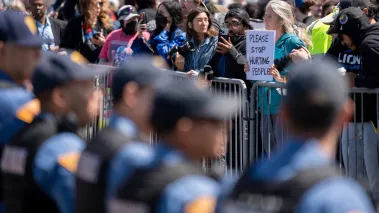
Julian Leshay Guadalupe / NorthJersey.com / USA TODAY NETWORK via Imagn Images
Protesters hold signs during an anti-ICE rally outside Delaney Hall on Saturday, May 30, 2026, in Newark.
Athena Rem is a rising junior at the University of California, Los Angeles, and a FIRE summer intern.
For more than three weeks, protesters have gathered outside Delaney Hall in Newark, New Jersey, amid allegations of rotten food, inadequate medical care, and other “torturous” conditions inside the immigration detention facility. Law enforcement’s response to the demonstrations has raised First Amendment concerns, particularly reports that officers have inflicted violence on clearly identified, law-abiding members of the press. A complete list of incidents is available via the U.S. Press Freedom Tracker.
David Delgado, a New York City photojournalist on assignment for Reuters, tried to take photos at Delaney Hall as protesters attempted to block police vehicles driving out of the facility. Delgado says that, despite visibly displaying his press badge, an officer made eye contact with him and then directly pepper sprayed him. The next day, when Delgado returned to the sidelines of the protests to observe, an officer reportedly threw a flash-bang device at him, causing him second-degree burns on his hand.
Journalists like Delgado have the same rights as other members of the public to observe, photograph, and record in public places. That includes the right to be free from the use of police force that seeks to prevent him from exercising those rights. And beyond retaliation, limits on expressive activity in public forums must leave open adequate alternative opportunities for such activity, including newsgathering. Delgado should not have been subjected to physical harm for basic journalism.
FIRE continues to survey and report on violations of individual rights, in and out of the courts, making sure protesters and journalists alike do not face punishment for exercising their First Amendment rights.
In another reported incident, a reporter and two photojournalists from WNBC were sitting in a press car separate from the main protest. The car was labeled as a WNBC vehicle and had a placard denoting them as press in the front window. As the protest started to escalate, police moved in on the crowd to push them back, even unleashing tear gas. The WNBC group stayed in the car, presuming they would be safe because they were far away from the general crowd of protesters. However, state troopers approached the car and forcibly pulled one of the journalists out onto the street. The trooper then instructed the other two occupants to leave the vehicle as well. They abandoned the car and ran away from a cloud of tear gas that surrounded the protest area and the car.
Police may use proportional and reasonable force to disperse protests that cross into unprotected conduct, such as those that turn violent or otherwise violate the law. However, no one should be subject to unnecessary force for peacefully exercising constitutional rights — including newsgathering and reporting. Reports that clearly identified journalists were attacked while simply documenting the demonstrations raise serious questions about the use of force and interference with newsgathering.
Of course, protesters have rights too. While violence and true threats may be punished, Americans are free to protest and criticize government actions and officials. That includes the right to criticize officers of the law without fear of arrest. At Delaney Hall, protesters exercised those rights by chanting, jeering at officers, and calling them names. However crude or offensive some may have found that expression, it remains protected by the First Amendment.
Yet some government officials have suggested otherwise. During a June 3 congressional hearing, Secretary of Homeland Security Markwayne Mullin threatened to find and arrest protesters who “verbally assault our officers.” But “verbal assault” is not a recognized exception to the First Amendment. If Secretary Mullin was referring to the exception for true threats — a serious expression of intent to inflict physical harm against an individual — he should have said so.
Know Your Rights: Protesting in Public
Peaceful protests are a time-honored way for Americans to make their voices heard and demand change that's protected by the First Amendment.
Without clarifying that he is indeed concerned with true threats, as narrowly defined by decades of First Amendment jurisprudence, Secretary Mullin sends a chilling message to protesters: Harsh words directed at law enforcement will be treated as criminal. The current administration’s repeated attempts to expand the boundaries of unprotected speech, including labeling speech about what federal agents are doing in public as “doxxing” and blurring the lines between protest and terrorism, make it even more important for officials like Secretary Mullin to speak carefully about what is and isn’t protected.
Violence is not acceptable or protected under the First Amendment, to be sure. But it violates freedom of the press when journalists actively face punishment or violence at the hands of public officials for gathering and reporting the news. Nor can freedom of speech thrive when the government floats vague and non-existent justifications for cracking down on peaceful protest that chill dissent.
FIRE continues to survey and report on violations of individual rights, in and out of the courts, making sure protesters and journalists alike do not face punishment for exercising their First Amendment rights.
Recent Articles
Get the latest free speech news and analysis from FIRE.

New Mexico's $25 billion verdict against Meta is fundamentally about speech
Silencing social media won't stop the unrest in France
FIRE is bringing the Free Speech Forum to the West Coast!