Table of Contents
New Jersey school board shuts down speaker for discussing his own ethics complaint
Dutchmen Photography / Shutterstock.com
Koen Rodabaugh is a rising 3L at University of North Carolina-Chapel Hill School of Law and a public advocacy legal intern at FIRE.
Last week, FIRE sent a letter to a New Jersey school board that apparently decided public discussion of complaints against it is only acceptable when the board likes what’s being said. When Dan Kleinman went before the North Hunterdon-Voorhees Board of Education to discuss the status of his ethics complaint, he was shut down over speculative concerns he’d reveal confidential information. Yet the board allowed a previous speaker to criticize the same complaint.
Apparently, confidentiality only runs one way.
On October 23, 2024, Kleinman filed an ethics complaint against board members regarding their handling of school library materials. He was prevented from discussing it on separate occasions, once by the board attorney and once by then-board president Kimberly Sorino. Instead of letting him speak, officials invoked an unwritten policy banning discussion of ethics complaints out of a supposed concern for confidentiality and the possibility of “defamatory” statements. However, in the second meeting, no such concern arose for the speaker who took a negative view of Kleinman’s complaint. Apparently, only Kleinman’s defense of his complaint was worthy of reprimand. That’s viewpoint discrimination, and it’s unconstitutional.
The First Amendment and New Jersey law provide robust protections for speakers at public meetings to discuss a wide range of relevant matters. The board’s current written policy allows any comments which are “related to the board’s conduct of the schools.”
Confidentiality was not a legitimate basis for limiting Kleinman’s speech, especially given that he was discussing the existence and status of his own complaint, which he posted online, and not revealing any confidential information. At the first meeting, Kleinman alleged a public board action violated state law and mentioned he filed an ethics complaint regarding that conduct, invoking no confidential information in the process. And at the second meeting, he merely noted that the complaint was still being reviewed and that the process was moving slowly.
Public meetings are meant to be the time for members of the public to engage with their representatives, participate in civic life, and petition the government for a redress of grievances. A growing number of government entities have instead insulated themselves from scrutiny through nebulous, selectively applied policies.
Certainly, the government can pursue its interest in keeping certain matters confidential by limiting what information the government will divulge. But it may not prevent members of the public from talking about what’s in the public record. If Kleinman has the right to publicly discuss his complaint elsewhere — which he does — he has the right to do so at school board meetings.
Nor is censorship justified by a board member’s concern that the speaker might say something “defamatory” or “slanderous.” No board member even claimed that Kleinman did say something defamatory, and in any event, such judgments are matters for courts to decide, not local politicians.
The board’s tactics are unfortunately nothing new. Rather, they follow a trend of government entities limiting critical public comments under dubious, selectively applied rules prohibiting discussion of government officials or employees. School boards and city councils across the country have relied on ostensibly viewpoint-neutral restrictions on discussing “employees” or “personnel matters,” or rules barring “defamatory” and “slanderous” speech to silence disfavored speakers. Government bodies also frequently use vague labels like “personal attack” and “abusive” to censor public comments — restrictions that by their nature single out critical speech.
But the First Amendment is clear: the rules for public comment periods at school board and city council meetings must be reasonable and viewpoint-neutral. And when even ostensibly viewpoint-neutral restrictions are selectively applied based on viewpoint, that’s flatly unconstitutional, regardless of the language’s façade of neutrality.
Prohibitions on discussions of “employees” and against potentially “defamatory” or “slanderous” speech grant governments far more power than the First Amendment allows to shut down speakers and put their thumb on the scale of any given public debate. Especially when these provisions are selectively applied, as happened to Mr. Kleinman, they represent a profound disrespect for the fundamental principle of “uninhibited, robust, and wide-open” debate.
That’s why last week, FIRE sent a letter to the board asking it to rescind any policy or practice that prohibits referencing ethics complaints during and to commit to allowing commenters to discuss such district-related matters going forward.
Government entities do have some ability to limit speech, but such restrictions must be tailored to the purpose of the forum. To that end, the board can implement policies to prevent actual disruption, such as exceeding the time limit for individual comments. What it cannot do is set the terms of the forum on paper and apply a different standard once someone’s speech becomes uncomfortable.
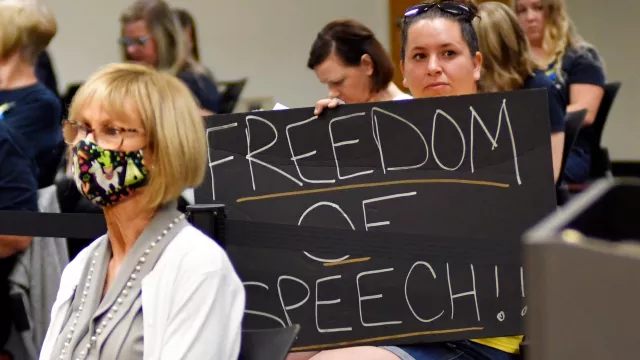
First Amendment protections for public comment at government meetings
When it comes to public comment periods, what are the free speech rights of citizens? And what limits does the First Amendment impose on public officials?
Speech might be controversial, tense, or disagreeable, but people have a right under the First Amendment to criticize government officials. Kleinman calmly delivered his critical remarks before being cut off. Even had he expressed himself more fervently, passionately, or caustically, his criticism would still have been protected. He came to the board meeting to discuss his ethics complaint, which relates directly to the actions of the school board and which he is free to discuss in any other public setting, but he was denied that opportunity, seemingly based on his views.
Public meetings are meant to be the time for members of the public to engage with their representatives, participate in civic life, and petition the government for a redress of grievances. A growing number of government entities have instead insulated themselves from scrutiny through nebulous, selectively applied policies. FIRE has been fighting back against this trend, and the North Hunterdon-Voorhees school board is the next government body we intend to hold accountable.
Recent Articles
Get the latest free speech news and analysis from FIRE.

Why you should talk to strangers w/ Fin Colleton and Kratima Divakar
Podcast
After a congressman challenged a student reporter’s right to record, here’s what journalists should know
Restoring Title IX kangaroo courts is no solution to the ‘Cornell 7’ sexual assault controversy