Table of Contents
LAWSUIT: FIRE announces lawsuit against Tennessee police department over pre-dawn raid at critic’s home
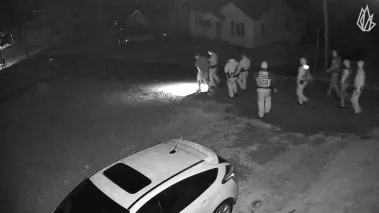
Kingsport officers lead Joshua Gibbons away in handcuffs.
- Police in Kingsport, Tennessee, staged the raid to arrest Joshua Gibbons after he filmed and criticized a speeding officer nine days earlier
- The arrest was conducted in a pre-dawn raid at his elderly mother’s home because of Gibbons’ online videos
- Kingsport put Gibbons through two criminal trials, but an appellate court found “no evidence” supported a disorderly conduct charge, clearing the way for a civil lawsuit against the city, its police chief, and its officers
KINGSPORT, Tenn., Sept. 22, 2026 — A Tennessee man who was arrested before dawn after he filmed police misconduct is announcing a lawsuit against the department for violating his First Amendment rights.
Joshua Gibbons filed the lawsuit in October 2023 with the help of the Foundation for Individual Rights and Expression. Now that the criminal charges against him have been dropped, he is taking his lawsuit public.
“They tried to intimidate me, but I’m not backing down,” Gibbons said. “I can’t let this injustice stand, because my family doesn’t feel safe anymore. There’s no coming back from that raid on our home. They sent eight heavily armed officers to arrest me because I embarrassed them.”
Gibbons adopted the moniker “Big G Audits” and uploads videos of police on duty as a means of holding them accountable. In October 2022, he filmed a Kingsport Police Department SUV speeding at night without lights or sirens in violation of department policy and state law. When Gibbons caught up with the officer at a fast food drive-thru, he filmed his brief denunciation of the officer’s conduct — an encounter lasting all of one minute.
COURTESY PHOTOS OF JOSHUA GIBBONS
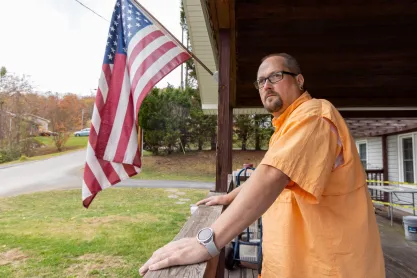
Shortly after posting the video, Gibbons posted a second video of a Kingsport officer flipping him off. When a citizen complained to the department about the officer’s conduct, the department scoured Gibbons’s YouTube channel for something — anything — they could use against him. They found the prior video of their own officer speeding — but set out to arrest Gibbons instead of disciplining the cop who broke the law.
Within two hours of being “made aware” of Gibbons’s video of the speeding officer, a Kingsport detective obtained an arrest warrant for speeding, using a cell phone while driving, and disorderly conduct — from a court clerk. Not a judge or lawyer, but a layperson working at the court.
Just before dawn the next morning, security camera and cell phone footage captured eight armed officers raiding Gibbon’s house and arresting him in front of his mother and daughter on a flimsy charge of disorderly conduct. Cell phone footage recorded an officer reciting the charges to Gibbons’s mother while her son was led away in handcuffs.
Kingsport then put him through two trials and left him in limbo for nearly four years — until he was recently cleared by a Tennessee appellate court, which finally threw the case out.
“This was as lawless as it was hypocritical,” said FIRE Senior Attorney Adam Steinbaugh. “The department’s actions were all to make an example out of a critic. Their officer was speeding and who do they arrest for it? The guy who filmed it.”
Gibbons’ lawsuit is the latest development in a nearly four-year legal saga.
The first judge to hear Gibbons’s case acquitted him of the speeding and cell phone charges, but found Gibbons guilty of disorderly conduct, saying he was “offended by the way” Gibbons was “talking to that officer.” Gibbons appealed to the county circuit court, which held a new trial, where a jury found him guilty of disorderly conduct.
In June, the Court of Criminal Appeals of Tennessee unanimously reversed the verdict and dismissed the last of the three criminal charges, finally ending the criminal case — three years and seven months after his arrest.
The appellate court found there was “no evidence” that Gibbons’s criticism of the officer “prevented any person from doing any lawful activity.” Everyone got their hamburgers, and none of the witnesses, despite their law enforcement backgrounds, “even got out of their cars.” Gibbons “did not threaten anyone, did not engage in any violent behavior, and did not create a physically offensive or hazardous condition.” The court explained that even “‘profane and insulting’ words alone will not rise to the level of a crime, particularly when uttered against the police, who ‘are trained to exercise a higher degree of restraint than the average citizen.’”
As the Supreme Court said in Houston v. Hill, the freedom to verbally “challenge” police “without thereby risking arrest is one of the principal characteristics by which we distinguish a free nation from a police state.” That’s true whether it’s federal agents or your local police.
“This wildly disproportionate response is Exhibit A in how police should not respond to criticism,” Steinbaugh said. “The First Amendment protects the right to film and criticize police officers without having to worry that you’re going to wake up in handcuffs. The Kingsport Police Department needs to hear that message loud and clear.”
Attorneys Timothy Horne and Assistant Public Defender (Appellate Division) Kendall Stivers Jones defended Gibbons in the criminal case. Richie Collins, Dan Channing Stanley, and Ursula Bailey are serving as local counsel in the civil action.
The Foundation for Individual Rights and Expression (FIRE) is a nonpartisan, nonprofit organization dedicated to defending and sustaining the individual rights of all Americans to free speech and free thought—the most essential qualities of liberty. FIRE educates Americans about the importance of these inalienable rights, promotes a culture of respect for these rights, and provides the means to preserve them.
CONTACT
Katie Stalcup, Communications Campaign Manager, FIRE: 215-717-3473; media@fire.org
Recent Articles
Get the latest free speech news and analysis from FIRE.

Venezuela is a cautionary tale w/ Jim Epstein and Germania Rodriguez Poleo
Podcast

FIRE sues Los Angeles City Council over policy banning certain words during public comment

It was never just going to be about keeping kids off social media