Table of Contents
Cassius Marcellus Clay brought cannons to a free press fight
Chris Henke / FIRE
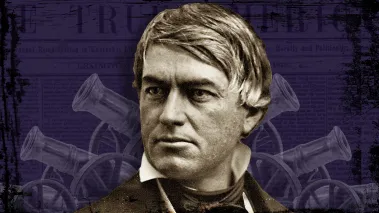
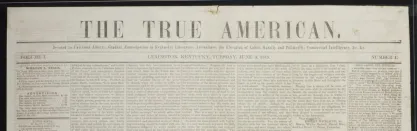
In June 1845, Cassius Marcellus Clay launched an anti-slavery newspaper in Lexington, Kentucky, one block from one of the largest slave markets in the United States. He called it The True American. Published by William L. Neale and edited by Clay, the paper openly challenged Kentucky’s slaveholding establishment. Its editor was a son of a Kentucky aristocrat; a cousin of the Great Compromiser, Henry Clay; and a man who understood that publishing against slavery in a slave state was not merely controversial. It was dangerous.
Clay’s father, Green Clay, was one of Kentucky’s wealthiest landowners and largest slaveholders. Cassius Clay graduated from Yale in 1832, where he heard abolitionist William Lloyd Garrison speak. Over time, Clay came to see slavery not only as a moral wrong, but as a political and economic poison that corrupted republican government, degraded free labor, and threatened liberty itself.
By the early 1840s, Clay had become one of the most hated men in the commonwealth of Kentucky because he would not stop talking about emancipation. His speeches brought threats and violence. In August 1843, at a political rally near Lexington, a hired gunman named Samuel Brown attacked Clay after Clay interrupted a pro-slavery speech. Brown hit and then shot Clay, who then lunged at Brown, cut his nose in half, cut off one of his ears, and gouged out one of his eyes. In 1849, after a debate between Clay and pro-slavery candidates for Kentucky’s constitutional convention, Cyrus Turner attacked Clay. A small crowd descended on Clay, hitting him, stabbing him in the side, and firing a revolver at his head four times. Each shot failed, discharging only the percussion cap. Clay fought off the men, wrenched his knife from another attacker by its blade, and slashed Turner’s abdomen with his Bowie knife, disemboweling him.
Kentucky did not tolerate a diversity of viewpoints when it came to slavery, and dissent on the matter was often met with violence. Kentucky had formal protections for free speech, but it would take a number of Supreme Court decisions before the people of Kentucky would actually begin to feel the shade of those protections. In the meantime, Clay made clear his silence would not come easily.
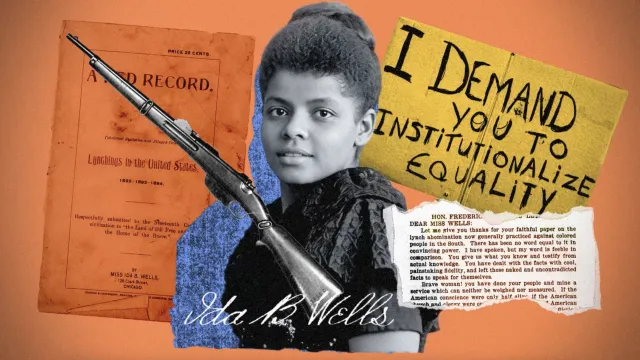
Ida B. Wells: Journalist, activist, civil rights icon, and free speech hero
In 1892, a mob destroyed a Memphis newspaper after it published an anti lynching editorial. Through death threats and violence, they tried to erase journalist Ida B. Wells’s message. Instead, they made her fight impossible to ignore.
When local papers refused to print his anti-slavery writings, Clay helped create one that would. The True American advocated gradual emancipation in Kentucky and attacked slavery as a threat to liberty, labor, and republican government. The title was a claim about the country itself: that fidelity to America meant defending liberty when liberty was unpopular. In Kentucky in 1845, even gradual emancipation was enough to make him a marked man. Threats against the paper began immediately, including death threats.
Clay prepared accordingly.
The office of The True American was not just a newspaper office. According to historian Herndon J. Evans, it was “armed with two brass cannons, iron barred windows, and an arsenal of Mexican lances and pikes. A trapdoor in the roof provided an escape route in case the editor and his helper found they could not hold the fort in an attack. In the basement, Clay had rigged up an ‘infernal machine’ with a powder keg that he could set off from the outside to blow up the building and whoever was in it should the attackers succeed in taking over the plant.” Clay later said he had filled the four-pounder cannons with shot and nails.
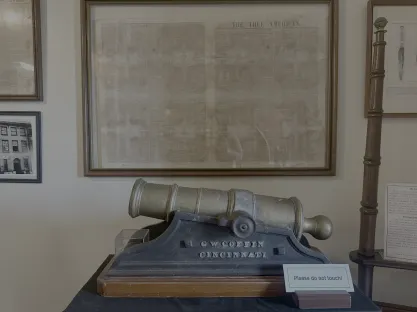
Clay’s cannons were not toys. They were his defense for a press operating where the formal promise of liberty could not be trusted to protect the act of publication. The issue was not simply whether Clay had a right to criticize slavery. It was whether he could actually print those criticisms in Lexington without having the press seized or destroyed.
The community of Lexington treated the paper as a public menace, organizing meetings and committees and demanding that Clay shut down his press. The flashpoint was an 1845 editorial, printed in Clay’s paper while he was bedridden with typhoid fever. Apparently written by a South Carolina planter, it warned that America’s betrayal of its founding ideals of liberty would bring retribution. The outraged people of Lexington ran Clay and his paper out of town, calling him “a fanatic and incendiary.” Claiming his press would “excite to sedition,” they quoted from the editorial:
But remember you who dwell in marble palaces — that there are strong arms and fiery hearts and iron pikes in the streets, and panes of glass only between them and the silver plate on the board, and the smooth skin woman on the ottoman.
The 60 or so men who made up one of the committees to shut down Clay’s press claimed to be defending “our wives, our children, our homes, our property, our country, our honor.” Their concern did not extend to black women and children, except insofar as enslaved people were counted among the “property” they meant to protect. And their chosen remedy was censoring a newspaper. “Do tell your secret conclave of cowardly assassins,” Clay answered defiantly, “that C. M. Clay knows his rights and how to defend them.”
As they gathered evidence against him, the men argued that printed words were more dangerous than action itself: “The plunder of our property, the kidnapping, stealing and abduction of our slaves, is a light evil in comparison with planting a seminary of their infernal doctrines in the very heart of our densest slave population.”
After a Lexington judge issued an injunction against the True American office and its equipment, Clay, bedridden with typhoid, yielded the keys to the city marshal. Later that day, the committee acted on a broader decree: “no Abolition Press ought to be tolerated in Kentucky, and none shall be in this City or its vicinity.” Even the mayor warned they were acting “in opposition to law,” but the committee seized the paper’s press and type and shipped them to Cincinnati. The mob, and slavery, had won. But the war wasn’t over.
Clay continued publishing The True American from Cincinnati, and in a small act of defiance, he kept the paper’s Lexington dateline — and kept sending copies back into Kentucky.
Figures of speech: The heroes and villains of free speech in American history
To commemorate the 250th anniversary of the United States, FIRE is proud to present the limited series “Figures of Speech,” looking at the heroes and villains of free speech in American history.
More than 165 years later, the Society of Professional Journalists recognized that legacy on April 12, 2011, when it designated White Hall, Clay’s home in Madison County, Kentucky, as a National Historic Site in Journalism because of Clay’s career as an anti-slavery publisher. The plaque honors Clay as a publisher whose press was attacked because of what he dared to print. The inspiring story of Cassius Clay reminds us that the basic principles of a free press are never tested when speech is popular or polite, but when a local community decides an argument is too controversial to tolerate.
More than a century later, another fighter would inherit Clay’s name. In 1942, a black child in Louisville was named Cassius Marcellus Clay Jr. after his father, a sign painter whose family had adopted the name of one of American slavery’s greatest enemies. But ironically, the young boy would grow up to reject “Cassius Clay” as a “slave name” and accept a new name bestowed by Elijah Muhammad: Muhammad Ali, after two central figures of Islam, the Prophet Muhammad and his cousin Ali, both slave owners. He became one of the greatest fighters in the history of the sport. But before he cast off the name Clay, it belonged to another legendary fighter, a white Kentucky aristocrat who attacked slavery with the power of the pulpit, the press, and, when necessary, brass cannons.
Recent Articles
Get the latest free speech news and analysis from FIRE.

New Mexico's $25 billion verdict against Meta is fundamentally about speech
Silencing social media won't stop the unrest in France

FIRE is bringing the Free Speech Forum to the West Coast!