Table of Contents
So to Speak Podcast Transcript: The fight for privacy and free speech in the surveillance age
Note: This is an unedited rush transcript. Please check any quotations against the audio recording.
Cindy Cohn: I think of both free speech and privacy as mechanisms by which we're able to control our government, and they're especially mechanisms by which people in power have a little less power over the rest of us.
Male Speaker: Somewhere I read of the freedom of speech. You're listening to So to Speak: The Free Speech Podcast, brought to you by FIRE, the Foundation for Individual Rights and Expression.
Nico Perrino: Welcome back to So to Speak: The Free Speech Podcast, where every other week we take an uncensored look at the world of free expression through the law, philosophy, and stories that define your right to free speech. I'm your host, Nico Perrino. In the 1990s, as the internet made its way into our homes and unlocked extraordinary possibilities for communication, creativity, and connection, but it also presented new civil liberties questions.
Do our offline freedoms exist online? And if so, how far do they extend? Today, those questions take on greater urgency as artificial intelligence becomes increasingly powerful, making it easier than ever for governments to track, monitor, and analyze our behavior. Cindy Cohn is the executive director of the Electronic Frontier Foundation. She has made a career out of defending rights in the digital world, which she documents in her newly-published memoir titled, Privacy's Defender, My 30-Year Fight Against Digital Surveillance. Cindy, welcome onto the show.
Cindy Cohn: Thank you so much.
Nico Perrino: So, my wife and I drove down to Durham, North Carolina this weekend for her reunion. She's a graduate of Duke. And on the drive down and the drive up, we listened to your book.
Cindy Cohn: Oh, my God. Well, thank your wife for me.
Nico Perrino: Well, my wife doesn't work in this space and she was riveted. She really liked it.
Cindy Cohn: Oh, thank you.
Nico Perrino: So, I think that's a testament to your writing and your writing for a lay audience. I like how you did a really good job of describing some of these legal terms for just a general audience. So, I was unsure how she'd feel about listening to this book four hours down there and four hours up, but she was into it. And you read the audiobook.
Cindy Cohn: I did. It was so fun. I got a chance to read it.
Nico Perrino: Tell me a little bit about that because I have a book coming out in January, and I'm slated to read the audiobook, and I'm a little bit nervous about it.
Cindy Cohn: I mean, I was very lucky. So, you know, one of my good friends in EFF's longtime staffers is Cory Doctorow. And Cory publishes lots of books and reads his own stuff. So, he hooked me up with his folks who do it. So, I got to have a very professional – I flew down to L.A., went into a real studio.
Nico Perrino: Oh, wow.
Cindy Cohn: Had real help. And they're just wonderful folks. Skydance is the name of the company. So, I just felt like I was so supported. I had real producers like, you know, "Hit that one harder, or try to say that…"
Nico Perrino: Oh, so they were having you do retakes?
Cindy Cohn: Yeah. Yeah. You know, and just really kind of giving me the confidence to read it and to read it anew. Right?
Nico Perrino: Yeah.
Cindy Cohn: As if it wasn't something I had written in the same way. So, they're great and it was really fun. The one thing that was a little hard to do was that I was under strict instructions not to speak except when I was reading the book. Because your voice gets tired.
Nico Perrino: Yeah.
Cindy Cohn: And so, I was down there for five days in L.A. in Studio City. And so, I'd finish reading the book, and then, I'd have to just kind of not talk to anybody for the rest of the time.
Nico Perrino: Well, if you're an introvert, that's a dream. It's an excuse.
Cindy Cohn: It would work for a lot of other people. And luckily, we all text now, so I wasn't unable to, but it was a strange thing. I've never been told not to speak before.
Nico Perrino: Well, I've talked with a historian who's written a number of books before, and one of the pieces of advice they gave for my book was before you finalize the book, read it aloud.
Cindy Cohn: Oh, yeah.
Nico Perrino: Because it can show you some things that don't quite read great on the page in a way that just kind of reading-reading does not. So, I have a – my book's with the copy editor right now. I have a plan to read it aloud just for myself, as I'm doing the final proofing. But then, I'm a little anxious about doing the audiobook because, I read these introductions to the podcast. This one was kind of a short one. And I found that it's really a talent to do a solid read when you're not seeing the audience that you're speaking to.
Cindy Cohn: Yeah. It was a little while, but I did do that. I did do the last read before it went back for the final thing out loud. And that was really wise. I mean, there was so many things that I caught that I wouldn't have caught with my eye.
Nico Perrino: And I'm sure some phrases that would have come out a little clunky if you're reading it aloud.
Cindy Cohn: Yeah. And placement of commas. And you know, there's just a lot of punctuation, too, where when you're reading it, you realize, "Oh, this should be a period, and then we should start the next sentence," you know, those kinds of things. So, yeah, it was a really good thing to do. And then, it's just a matter of focus and slowing down. And again, having coaching. I had real coaching through it.
Nico Perrino: Yeah.
Cindy Cohn: So, and after a while, you just get the rhythm. I love to listen to audiobooks, which is why I was nervous about being the person because I've listened to a few, where the author read it, and it wasn't all that great. And so, they – but they encouraged me because – and you'll be great. You have a good voice.
Nico Perrino: Yours is a memoir. You have to read it. You know?
Cindy Cohn: Well, that was part of it. And also, you know, we have EFF's podcast, and I've done media for a while. So, you kind of have a basic understanding about how to do these things. But it was a new experience, and it was fun. I highly recommend it. You should do it.
Nico Perrino: Why write the book now? I mean, I saw the book came out, and then, you announced you're leaving –
Cindy Cohn: Yes.
Nico Perrino: – as executive director of the Electronic Frontier Foundation. So, did you know that was going to happen when you started writing this memoir?
Cindy Cohn: Not when I started, but as I was getting into the memoir, I thought timing... I wanted the book to come out while I was still at EFF because it's really EFF's story, and I didn't want it to look like something – I wanted to be able to promote it, and talk about it, and talk about the organization while I was still there. So, I basically made sure I wasn't leaving until the book came out. And so, it just all kind of aligned. I would say that trying to leave an organization you've been at for 26 years, while at the same time doing a book tour sounded really good, and is not turning out to be so great.
Nico Perrino: And you're completely leaving.
Cindy Cohn: Well, I'm going to leave EFF. I don't want to leave the space. I want to keep fighting. These stories that I tell in the book are all about me being the lawyer.
Nico Perrino: Yeah.
Cindy Cohn: Me, writing the briefs, standing up in court, building the team, doing that kind of work. And the further, you know, as executive director of a 120-person organization, the amount of time I get to do that part of the job just keeps getting smaller and smaller, for good reason.
Nico Perrino: Yeah.
Cindy Cohn: Right? You know, organization needs the care and feeding of an executive director. So, thinking about who I am in the world, I'm much more of a warrior than I am somebody who wants to lead 120 people. And so, I really want to get back to the part of this fight that got me into it in the first place. So, we'll see. You know, sometimes they say you can't go home again. And in order to do that, I need to leave EFF. I don't think it will be fair.
Nicole Osier, who is a longtime friend and fellow traveler of EFF, has decided – has agreed to come in going to be our new executive director. She's going to be fabulous. But she won't be able to take over unless I leave. You know, there is something about having the old boss hanging around.
Nico Perrino: Yeah. Especially the old boss who'd been there for 25 years.
Cindy Cohn: Exactly.
Nico Perrino: And shaped what the organization has become.
Cindy Cohn: Yeah. I just wouldn't want to – I wouldn't want to put her –
Nico Perrino: Be a big shadow.
Cindy Cohn: – or anybody else under that because she's going to be great. She's different than me in that I'm – again, I was kind of a litigator who got pushed into leadership. I think we did really well. She's actually somebody who wants to lead and do strategic thinking and planning, and she's fabulous. So, she built the ACLU's speech technology and privacy group in the northern district of California, which was the first one. She convinced the ACLU that they needed to think about tech and built it out. And so, that's great. She's going to be the right person for EFF.
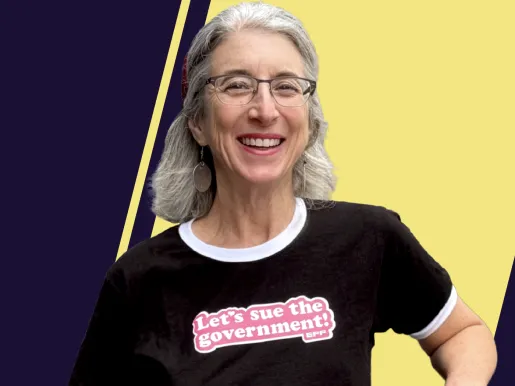
But, you know, sometimes you gotta leave the stage for somebody else to take the stage. And I'm starting to think about what I want to do next. And I'm not sure, yet. I'm trying to take a little time and see what opportunities come up. But they made this shirt for me.
Nico Perrino: I was going to say, so you're going to still sue the government, then?
Cindy Cohn: Yeah, I got – they made the shirt that says –
Nico Perrino: For our listeners who aren't seeing the video, her shirt says, "Let's sue the government," with an exclamation point.
Cindy Cohn: Yeah. And my designers are amazing, and they made this shirt, I think, largely for me, they – that all the EFF lawyers sue the government. But when I told the staff that I was leaving, I said, "I don't think I'm done suing the government, yet." So, we'll see. We'll see.
Nico Perrino: Tell our listeners who might not be that familiar with the Electronic Frontier Foundation who you are and what you do. Your book focuses on privacy and your fight against the surveillance state, but the work is more expansive than that.
Cindy Cohn: Yeah. And in fact, you know, two of the three stories in the book are actually free speech cases. Right?
Nico Perrino: Yeah.
Cindy Cohn: These are the arguments that we make.
Nico Perrino: And we're going to dive into those. Yeah.
Cindy Cohn: Yeah. It was a hard call, like, "How do I characterize this work?" Right? But I felt like privacy in some ways, is under defended and that it's an important piece. I actually think free speech and privacy go together.
Nico Perrino: Can you explain that a little bit? Because I don't think folks quite understand that. They have an intuitive sense that they go together, but it's not very easy to articulate.
Cindy Cohn: Yeah, I mean, look, I think both – I think free speech and privacy are both things that were put into the Constitution in order to make sure that we were self-governing, in order to make sure that we had the space we needed to be able to elect the people of our choosing and hold them to account. Right? On a very basic level. Right? Our country was founded by people who had to speak in code to each other.
Nico Perrino: I love that part of your book.
Cindy Cohn: Yeah. You know, Jefferson was in Paris. Madison was in – I mean, Adams was in London. Madison and the rest of them were in the U.S. They had to speak in code in order to not be found out by the king that they were plotting a revolution. They understood that in order to engage in self-government, they needed a zone of secrecy. They needed a way that they could talk to each other, associate with each other in ways that people in power could not see in order to organize a revolution. So, speech is really important. You have to be able to say what you think. Privacy is very important because you have to be able to organize, associate, and build community.
And all the social movements that we've had in my lifetime, and I think even earlier, had to have a private place before they could have a public place. You see this, it's throughout our constitutional rights. Right? We have the right to vote in private. Right? We have a private vote. Right? Because otherwise, people who have more power could make sure that you voted for the ones that you wanted. This is a problem in a lot of other countries, where the boss tells you who to vote for. Right? It's actually a labor problem in a lot of places. Other places, it's the husband tells the wife how to vote.
The zone of secrecy we have over when we walk into the ballot, the booth or whatever in front of that little machine and make our ballot is critical to self-government because then, people can vote for who they think the right person is, not who powerful people want them to. So, I think of both free speech and privacy as mechanisms by which we're able to control our government, and they're especially mechanisms by which people in power have a little less power over the rest of us.
Nico Perrino: Yeah. Well, one of the retorts you often hear to people who are vociferous advocates for privacy is, "Well, why are you so concerned with privacy if you have nothing to hide? If you're not doing anything illegal." I'm sure you hear that all the time.
Cindy Cohn: All the time.
Nico Perrino: But it's the one thing that you'll hear from the other side without question. It's like a tick.
Cindy Cohn: Yeah. Well, and I think the – look, there's a couple of ways to think about that. The first way to think about that is, that's because you're in power. And people who have less power who might want to change your world, yeah, privacy might not be for you, if you're already at the top of the food chain in this country, and you like it that way. And you like the way things are, and you don't want any change. Privacy and free speech, honestly, I think, are really important tools for people who want change. They're both less important for people who don't want change. Right?
You know, you don't need to speak. You don't need to go to Speaker's Corner to talk about how everything's great. Right? I always say, you don't need the right to free speech for popular speech. That's not why we have it.
Nico Perrino: Yeah.
Cindy Cohn: It's the same thing for privacy. So, I say that. The other thing I say is that don't be so sure that you have nothing to hide, so you have nothing to fear as circumstances change. Right? I have been doing this for a long time. I started in the '90s. The government has shifted who's in power multiple times throughout this, and the people who have come to us and said, "We need protection against the government censorship" have also shifted. And it goes – back and forth might not be right. It goes round and round, right?
Nico Perrino: Sure.
Cindy Cohn: Sometimes. And I think there's a moment pretty recently, right, when Roe v. Wade was overturned by the Dobbs decision, where suddenly, a lot of people in this country who didn't think they had anything to hide suddenly found out that they did. And that if they were in a state that didn't support the right to abortion, it wasn't just that you couldn't get one, it's that you couldn't talk to people about it, you couldn't help them, you couldn't do all sorts of speech activities. EFF wrote a report about censoring abortion information off the internet.
So, that's one moment where I think it was pretty easy to point to a chunk of people who would have said, "I had nothing to hide," who suddenly felt like maybe they did.
Nico Perrino: Yeah.
Cindy Cohn: And I don't say that because that's one moment. I say that because that's how it always is. It's just that you're not in the crosshairs all the time.
Nico Perrino: Yeah.
Cindy Cohn: And I also think the other piece I would say is even if you're not, I think privacy is a team sport. I actually think free speech is a team sport.
Nico Perrino: I mean, all of these rights are sort of a team sport.
Cindy Cohn: Yeah. So, you've got to think not just about yourself, but who you communicate with, who you love, who's in your life, and whether they're put at risk by what's happening. I just think that's part of living in a society. And it's especially true about privacy because if you don't care about your privacy, but the cops get a hold of your contact list, it's not just you who is put at risk. So, quite – it's not just like, "Oh, we live in a society, we should all care about each other." It's actually very literally, you can put other people at risk if you're not careful about how you're thinking about privacy in your communication sometimes.
Nico Perrino: Well, let's talk about how you got into this work.
Cindy Cohn: Yeah, we jumped way ahead.
Nico Perrino: Well, yeah, we're framing it up so people kind of understand the scope of your work. But I wanna nail it down with a couple of concrete stories here. Starting with how you just got into the work in the first place because you did not go to law school thinking you'd be working at the intersection of privacy, free speech, the Constitution, and tech. Right?
Cindy Cohn: Yeah. No, this job didn't exist when I was in law school. And even if it did, I wouldn't be one of the people. I was an English major, and I did international human rights law. I worked in Geneva, at the UN, for a little while. But what really happened was I was living in San Francisco, getting started in my law career, and I kind of stumbled into meeting a bunch of hackers. And I use, "Hackers" deliberately because I think we need to reclaim that term from the people who took it from us.
Nico Perrino: Yeah. You talk about how you need to reclaim the term in the book. Yeah.
Cindy Cohn: It just drives me crazy. It's just one of my little – everybody has a pet peeve. That's one of my pet peeves.
Nico Perrino: Yeah, I mean, what does a hacker mean in your formulation?
Cindy Cohn: In my world, a hacker is somebody who literally hacks at a problem the way somebody with a small axe would hack at a large tree. And it grew up in the early internet. Remember, this is all 1990s, before the World Wide Web. But the early internet, you kind of had to dig your way through in order to make your tools work. A lot of people were building their own tools. A lot of people had to do a lot of problem solving. You just didn't get handed a pretty, little interface and then it worked magically. Right?
Nico Perrino: So, there was some commitment in order to do this. It became a part of – it almost had to become a part of your identity if you were going to invest this much time.
Cindy Cohn: Absolutely. And so, I met some of the hackers, some of them worked for the Free Software Foundation in Cambridge, but they were living in the Bay Area, and they were in constant communication back and forth in these green screens with yellow – these black screens with green letters. And they were collaborating, cooperating, communicating across mass distance cheaply, freely, and all the time. And this doesn't sound like much now. We all do this. Right? This is – we're recording this podcast, there's people in Philadelphia, it's going to be broadcast on the internet. Distance doesn't matter anymore in the way that it did.
But these guys were already living there. And I thought this was going to be an amazing and interesting, and somewhat dangerous moment when the rest of us got access to this communication tool. And as it turned out, they were already thinking this way. And one of them was a guy named John Gilmore, who had founded the Electronic Frontier Foundation with Mitch Kapor and John Perry Barlow in 1990. I met these guys in '91. And so, they were already thinking as well about what the world would be like when everybody else got this.
And they were really thinking about how to set this new world up in a way that stood with users, not only them as hackers, but future users, as well as – and what were the obstacles that were going to get in the way. And the first one that they identified was there wasn't a lot of security or privacy in this new digital world. And that was because – in part, because the U.S. government treated the technology that would give us all security and privacy, called encryption, like a weapon. It was on the U.S. munitions list, which is the list of things that you cannot export from the United States without a license. So, on this list is like, surface-to-air missiles, and tanks, and software with the capability of maintaining secrecy.
Nico Perrino: So, if I were talking with you on Signal or WhatsApp right now, the technology that keeps those conversations private was considered by the United States government, to be a munition, effectively.
Cindy Cohn: Correct. Correct.
Nico Perrino: This is the '90s.
Cindy Cohn: This is the '90s. And it needed to change. I understood why it was on that list to begin with. If you know your history, you know the U.S. government won – the Allies won World War II in part because we broke the German's codes and the Japanese codes, the Enigma machine, the purple machine. We were able to break their codes and that was partially how we're credited with winning the war. So, it makes sense that the military thought it was one of theirs. But we knew with the coming digital revolution that it was going to need to be available to all the rest of us, if we were going to have privacy and security online.
And so, you wouldn't have Signal, You wouldn't have – there's a lot of things under the hood of the internet now that have encryption that make sure that when you type in the name of your bank, you actually go to your bank and not some third party that's hijacked your traffic. There's lots of places –
Nico Perrino: So, when I go to my web browser and I see, "https."
Cindy Cohn: Yeah.
Nico Perrino: That means it's secure in a way, if I just go to the HTTP, it's not.
Cindy Cohn: Correct.
Nico Perrino: That's what this is?
Cindy Cohn: Correct. That means that – the "S" means that there's some encryption protecting your little request that goes to where you're going. And on the way back, it doesn't – obviously, the endpoint has to know what you want and you need. But in between, it gets encrypted. That's what the "S" means. And so, it was –
Nico Perrino: Kind of important if you're submitting your credit card information or your social security information on the internet.
Cindy Cohn: Yeah, I think it made commerce on the internet possible.
Nico Perrino: Yeah.
Cindy Cohn: Yeah. And that's why we weren't alone in this. I mean, we started this kind of as a lonely fight among some hackers and a young lawyer who didn't know what she was doing. And of course, FIRE's own Bob Corn-Revere joined the fight pretty early. So, we had heavyweight help pretty soon. But it was also something that a lot of people in Silicon Valley were interested in because they saw the possibilities of commerce. And they also saw the possibilities of actually doing business or other things. You know, you need privacy when you use your credit card, but people also need privacy when they're developing an idea sometimes. Right? Trade secrecy and things like that.
So, we took on this – so, this was a licensing scheme. Our client was a math PhD student at UC Berkeley named Dan Bernstein. He had written a little computer program that for the geeky folks, was somewhat clever, but for the non-geeky folks, all that matters is it was strong enough encryption that the government would say, "No." And he had already asked for a license when they brought me in, and they had told him no. And we mounted a First Amendment challenge saying that the government's regulations, because they stopped him from publishing his computer code on the internet, amounted to a prior restraint on speech.
That's the part of the free speech doctrine that says, "If you have to go to the government and get a license, the government has to meet really, really high standards in order for it to pass constitutional muster."
Nico Perrino: And that's one of the oldest First Amendment free speech doctrines there are. I mean, whatever you think of the original intent of the First Amendment, I think people have always kind of understood that this restriction or this prohibition against prior restraints was there.
Cindy Cohn: Sure. I mean, the first thing that a despot wants to do is make sure you can't speak without getting a license from them. Right? A government license to speak is one of the ways that you – you know, direct censorship, you'll go to jail if you don't speak, that's important. That's another thing. But governments are clever.
Nico Perrino: Yeah.
Cindy Cohn: You know? It's a licensing scheme so that they ultimately still maintain control, but it doesn't look like it so much.
Nico Perrino: But you had to convince the court here that the code that creates this technology is speech.
Cindy Cohn: Yes.
Nico Perrino: And it's not like the code is just telling the computer in plain English, "Please encrypt this. Please keep it private." I mean, it's using language that a non-technician probably presumably couldn't understand.
Cindy Cohn: Yeah. I mean, cryptography has always been a kind of applied math. Right? It's math. It's just a particular application of math, and it's really interesting math, actually. There's a lot of fun stuff. And it was ever so. Right? There's an old cipher, the Caesar cipher. Right? You take an A, and you replace it with the letter, one, and – you know, that's not the Caesar cipher. But like a rot13.
Nico Perrino: Sure.
Cindy Cohn: Where you move things 13… So, it's always been a kind of applied math to do secret codes. And so, that's what encryption was. So, what Dan's computer program was, was a set of instructions. Actually, it was source code. So, it was a set of instructions that couldn't be read by a computer just yet. It has to be, especially, in the olden days, you had to take the source code and turn it into object code, that turned it into assembly language, and then, the computer could read it. But that was what he wanted to publish. And so, our argument is that Coded speech is the short version of it, but this is a kind of applied math, this is a science, this is a scientific publication.
Nico Perrino: This is a scholar sharing effectively, math equations.
Cindy Cohn: Yes, absolutely.
Nico Perrino: Yeah.
Cindy Cohn: Absolutely. Or any other kind of science. Right? Or the analogy that we used a lot with the judge was it was like a recipe. Right? Because that's kind of what computer programs are. They're like, break a big task up into tiny little steps that are tiny enough that a computer can do them. And you write them in that specialized way, and then, the computer can do it. It's like, "Take two eggs, add the butter, fold in, and then, at the end of it, you get the cake." Right? It's a lot. That's one of the analogies that you use.
Nico Perrino: I imagine you're using a lot of analogies in your line of work when you're trying to translate analog era rights to digital rights.
Cindy Cohn: Absolutely, and especially in the '90s. Sometimes, I'd show up in court, and I'd feel like I was kind of this weird lawyer from the future. So, we used a lot of analogies, but I still do. I mean, I still think that – you asked me, kind of harking back, how did a lawyer like me who doesn't have any technical background, really, any serious technical background get into this. And I think that it's in part because I wasn't of the tech that I was able to really take the role as translator, and sit, and listen to the technical people who will – believe me, technical people love to tell you what they're doing and how they're doing. It's great.
So, you sit, and you listen, and you really try to figure out, "How do I take this world and translate it into something that somebody who wears a black robe all day in the judiciary or a congressional staffer, that they can understand?" And I think that's one of the ways, the reasons that we were pretty successful, is that we didn't force – we tried to find ways that were truthful and honest, but to make it relatable to somebody who didn't come out of the technical background.
Nico Perrino: So, you take this case to court, and the argument from the government on the other side is that the speech is more functional than expressive. That speech is telling something or someone to do something, and in that case, it loses First Amendment protection. How did the courts respond to this argument?
Cindy Cohn: Yeah, I mean, the court basically said, "Well, if the speech allowed you to do something, and it was functional, and that made it have no First Amendment protection, we're going to have almost no First Amendment left." Right?
Nico Perrino: Yeah. To communicate, to hopefully produce some sort of outcome.
Cindy Cohn: We always want an outcome. And so, the court basically said – there was a quote from – I think the Ninth Circuit that said, "The admixture of a drop of functionality cannot mean that speech is no longer speech." Right? Because that's really the argument.
Nico Perrino: The recipe analogy there. Yeah.
Cindy Cohn: Exactly. But I mean, in the case of encryption, we also had a second argument that I think was also helpful, which is, this is actually science. I mean, what Dan Bernstein wanted to do was publish code on the internet, so other people in cryptography could look at it, comment on it, help him make it better. What he actually wanted to do was actually felt, I think, and rightly so, like Heartland's speech. He wanted to publish his ideas and let other people think about it and talk about it. And the fact that coded speech was something that the whole hacker community did – you know, we put code on – they put code, I didn't do this, so I shouldn't keep saying, "We" – put code on T-shirts.
I think there was one guy who put encryption code as a tattoo to point out that this is speech. It's just speech that is a kind of language that maybe not everybody can understand, but tons of languages aren't languages that everybody can understand. And especially, when you get into science. Right? You get into these rarefied specified languages for specialists to talk to each other in a very precise way. Well, I mean, we do this in the law, too. Right? We have our own version of a lot of words.
Nico Perrino: There's a lot of Latin in there, too.
Cindy Cohn: Yeah. And so, that's the – that argument was part and parcel of kind of making the argument to the court about speech. And we were lucky. We had Hal Abelson, who's a storied professor at MIT. He teaches the introduction to computer programming class that so many people who've gone on to make billions of dollars started there.
Nico Perrino: Yeah.
Cindy Cohn: And he sat down with me and talked to me about what code is. And he famously said, "Code is written for other people to read and only secondarily for computers to execute." You don't have to believe me on that.
Nico Perrino: Yeah.
Cindy Cohn: You can talk to the dude who teaches everybody else. And we brought in a whole bunch of other people like that where – because it was such an – inside the scientific and computer science world, this is not a controversial thing. So, it was easy to get well-known people to just say this, so we could then go to the court and say, "This is protecting science. It's important to protect science. And you shouldn't let the digital nature, scary, scary national security kind of story that the government's telling you distract you from that fundamental truth."
Nico Perrino: Well, it's also a truth that the government itself recognized in the '70s. Right? You talk about how there was a legal advisory document, maybe from the Office of Legal Counsel, I forget where.
Cindy Cohn: Yeah.
Nico Perrino: That said effectively the same thing that you guys were making in your briefs.
Cindy Cohn: Yeah.
Nico Perrino: That this would be – this raised First Amendment free speech concerns.
Cindy Cohn: Yeah. And it shows the long distance between the Office of Legal, it was the OLC, memos, and the rest of the world. Because that thing had been sitting there since the '70s. Right? And it wasn't until we were able to marshal a case in the '90s that we were able to actually take what the OLC said and turn it into some change for people in the world.
Nico Perrino: So, you won.
Cindy Cohn: We did win. We won in the district court, and we won in the Ninth Circuit. And then...
Nico Perrino: One of the great tragedies.
Cindy Cohn: Yeah, I know, this is a horrible tragedy. It's a personal tragedy. It doesn't really affect the rest of the world the way it affects me. But we won at the Ninth Circuit in a three-judge panel. And then, the government asked for what's called, "En banc review." This is something we do out in the Ninth Circuit a lot. Other circuits do it, as well, but the Ninth Circuit's so big, and it has so many judges that it's pretty common to ask for a larger panel of judges to look over what a smaller panel did before you take the thing to the Supreme Court.
I'm assuming your audience understands the law and well enough to get this, but back me up if you need to. And so, while they asked for en banc review, and the Ninth Circuit granted it, and while we were in the midst of briefing this, essentially, the government backed down. And they deregulated encryption in a very dramatic way, giving us 90, 95% of what we wanted. What that meant for the world was amazing. We all get encryption. What that meant for me was that my citable precedent in the Ninth Circuit wasn't citable anymore because the case basically got resolved before a final judgment.
Nico Perrino: Because that panel decision gets suspended and remains on suspension presumably.
Cindy Cohn: Forever.
Nico Perrino: Forever until the en banc review either gets denied, or they issue a new decision.
Cindy Cohn: Correct. And since they never issued a new decision because the government gave up, I never got my new decision. Now, again, it's great. We got the regulations back down. There's actually, our Ninth Circuit decision still remains instructive, and lots of judges have relied on it. And the good news is there was another case moving along in the Sixth Circuit, a guy named Peter Younger, and we were all working together. But Peter's case, the Sixth Circuit followed what the Ninth Circuit did, held the coded speech. And that case was not appealed. So, the Sixth Circuit law is the good law. The Ninth Circuit law is instructive. And I didn't get my precedent, but the world got encryption. So, I feel like it's a fair deal.
Nico Perrino: Yeah. Do I recall correctly in your book, you say the Sixth Circuit decision is good, but it's not as eloquent as the decision you got in the Ninth? It was more workman-like.
Cindy Cohn: Yeah, I think. Well, they were following. Right? But also, yeah, I just – we got lucky with Judge Fletcher, who is our judge who wrote the decision. It's got a lot of soaring, beautiful language in it about the value of encryption's bounty, giving us back some privacy we may have lost in the digital age.
Nico Perrino: You have that tattoo, right?
Cindy Cohn: Yeah. I actually have put it on some EFF stuff, but it reads better in the document. But, yeah, it was a much more – I think she was aware that she was breaking new ground and wanted to make it really clear, whereas the Sixth Circuit, was kind of more following.
Nico Perrino: Yeah. Well, when I hear about or think about these encryption cases, I often think of the Bernstein one. Maybe it's because it had a higher profile, maybe it's because it had some of that soaring language in those decisions. And maybe it's because I don't litigate these issues very often, or ever, because I'm not a lawyer. But for whatever reason, I hear about the Bernstein case more than I do the younger one.
Cindy Cohn: Yeah. I think we've won the – I mean, it wasn't really a competition, but yeah, Bernstein has really become the one that people think about. It's only in the kind of legal weeds that you realize that actually, it's the younger case that you can rely on in citing things. And you know, it's gone on. It's been cited in lots of other kinds of contexts, as well, now. So…
Nico Perrino: You had talked earlier about how free speech and privacy are both democratic values, although they have non-democratic support. Right? They're in the Constitution. A democracy can't just overturn your right to free speech and privacy.
Cindy Cohn: Oh, yeah.
Nico Perrino: But the government, in reading your book, seems to think any time it says, "National security," that these values go out the window. You saw that, of course, in the Bernstein case, but you also saw it in the other two stories that you talk about in your book. I want to talk about the post-9/11 government spying efforts. And in particular, start, as your book chronicles it, with the government sitting on the wire, as you put it.
Cindy Cohn: Yeah.
Nico Perrino: You tell the story about this man who comes to your office and says, "The government effectively, in cahoots with AT&T, built a back door to monitor all communications that Americans have…" with each other? With foreigners? How did it work?
Cindy Cohn: So, yes, so the man was Mark Klein. And one of my great sadnesses is he passed away last year. And so, he didn't get to see this book written. He wrote his own book called Hooking Up the Big Brother Machine, which is a good read, if you're going to be a deep geek about these things.
Nico Perrino: And I should say he worked at AT&T, so that's how he knew about this.
Cindy Cohn: He was an AT&T engineer, and he had been adjacent to where the government after 9/11 had built a secret room – we call it a secret room. It's Room 641A on the sixth floor of the Folsom Street Facility in San Francisco. And he had hooked up some of the connections between the internet backbone and this secret room. So, it included some domestic communications, I think where it is placed, it was aimed at stuff that had just come in from overseas, but there's some – we didn't ever get the kind of discovery in the case to let us be sure about that.
But given where – I mean, San Francisco is not on the border, so it wasn't right as it came in the U.S. It was a couple hops in. But I think what they were aiming at is international traffic. So, it could be from the U.S. to somebody abroad, or foreign-to-foreign traffic that happens to route through the U.S. I think those were the things that they were really aiming at. So, what they did was kind of, I think, kind of technically clever. You know, communications travel on beams of light. Right? That's what a fiber optic cable is.
They installed a bank of fiber optic splitters, which take the light and split it in two. And the thing that's cool about light is if you split it in two, you don't get halfsies, you get a full copy of everything.
Nico Perrino: It's like a copy machine.
Cindy Cohn: Yeah, it's like a copy machine. And so, they've installed a bank of splitters, they brought in this traffic, and one copy of the traffic went on its way, and the other copy of the traffic went into the secret room. And it had a lot of complicated analysis machines in it, but we don't know what they were doing in that secret room, but they got a copy of everything.
Nico Perrino: But by going to the secret room… So, it's one beam of light goes to the recipient of the communication, the other beam of light goes to the government, effectively.
Cindy Cohn: Correct. Absolutely.
Nico Perrino: Did Americans know this was happening when Mark walked to your door? Was there this understanding in the post-9/11 world that the government was going to sit on the wire and monitor communications between foreigners and American citizens?
Cindy Cohn: No. No, this was all secret. So, after September 11th, the Patriot Act passed, and that had some stuff in it, it did not have sitting on the wire or tapping into the internet backbone in it. It had some stuff that later, the government tried to interpret as letting them collect everybody's phone records, but there's nothing about this program, which was ultimately, we learned, called Upstream. And Upstream in the internet, that's where they tapped in. They're descriptive. But we had heard rumors that there was this massive data collection going on, but we couldn't get any evidence of it.
And in late December 2005, the New York Times ran a story that said, "Bush is tapping in on Americans inside the U.S." And that caused a huge uproar at the time. And then, in early January 2006, just right after that, Mr. Klein knocked on the front door of EFF, and said, "Do you guys care about privacy?" He had read the New York Times story and said, "I think that weird thing that I hooked up might be how they're doing this." And he had the schematics with him. He had actually – he had recently retired from AT&T, but he thought something was weird.
And so, he had taken a bunch of documents, he'd taken some photos of the room. He thought something was weird, but he didn't quite know what it was. And it wasn't until that New York Times story came out that he kind of put it together and showed up at our front door. So, we had heard that there were things going on, but we didn't have enough evidence to do anything. And then, he walked in with the schematics of this thing. And we were just floored that we'd gone from whispers and maybe, and maybe to, "Oh, here's exactly how this thing works."
Nico Perrino: Wow.
Cindy Cohn: So, we brought a lawsuit based on his evidence, and some of the evidence about the phone records, and the internet metadata program. There were two other programs that we were researching at the time.
Nico Perrino: But your lawsuit, one of the arguments you make is that it doesn't matter what the government's doing with this information. In fact, you didn't know what the government was doing with this information.
Cindy Cohn: Right.
Nico Perrino: The mere fact that it was collecting it was unconstitutional.
Cindy Cohn: Right. Correct.
Nico Perrino: Did the government say that mattered? Did the courts care that all you were challenging was the mere collection? It seemed like the course through the courts was very complicated, convoluted, and there were a lot of roadblocks thrown in your way. And you kept just saying, "We don't need any more information. We know that they are doing this, and that's all the court needs to know to rule that this activity is unconstitutional."
Cindy Cohn: Correct. And that was our argument, or a violation of the Wiretap Act. I mean, the Wiretap, the FISA law, the Federal Foreign Intelligence Surveillance Law, really says accessing this information is the point at which you need, a FISA court warrant or other kind of warrant. It's when the government has access to your communications that you should need this. And boy, we tried. You know, we just could not. We couldn't. The government's kind of distortion field around what we were claiming and what we needed to prove in order to make our case work…
You know, it didn't work at first, but then, it slowly started to work. And ultimately, the Supreme Court agreed that the state secrets privilege meant that we couldn't go forward with the case. It was too secret for the courts to decide whether the Fourth Amendment was being, or the law was being violated by the government affecting millions of Americans. I still can't even say it without pausing, because it seems so ridiculous.
Nico Perrino: Yeah, you're lowering your eyebrows here, you're like, "It doesn't really make sense," but we had reporting and information that this was happening. So, what's so secret about something everyone knows about? And why can't you challenge that?
Cindy Cohn: Well, that was the other piece of it, as well. You know, when we started, it was secret, but of course, over time, it became less and less secret. There was a lot of good reporting. And then, in 2013, you may recall a dude named Edward Snowden came out with a whole bunch more evidence. And after that –
Nico Perrino: I had a picture of him with his laptop and the EFF sticker on it.
Cindy Cohn: Yeah, that sticker. You know, you never know who's watching what you do. And the very first conversation I had with his lawyer, Ben Weisner, at the ACLU, was, I said, "Please tell him thanks." And he said, "Well, he wants to know if you have standing, yet."
Nico Perrino: So, he was watching the lawsuit.
Cindy Cohn: Because he was watching, he knew. I mean, the main thing he was very upset that the NSA lied to Senator Wyden in a hearing about this. But...
Nico Perrino: Oh, that's a crazy story, too, that there was this hearing on these programs. And who was it?
Cindy Cohn: Clapper, I think.
Nico Perrino: Yeah, it was Clapper, lied that this program was happening. And the government's argument was, well, the congressmen and women, they knew it was happening. So, the fact that he said it wasn't publicly was not lying to Congress because they knew –
Cindy Cohn: They knew anyway. Right?
Nico Perrino: Yeah.
Cindy Cohn: But all the rest of us were watching. He also said, "Not wittingly," which I think is a tell to what they're doing with 702 and a lot of this mass spying today, where they say, "Well, our targets are people abroad." So, everybody else who's just swept up in that is just kind of unintentionally collected. So, it shouldn't matter. Of course, there's a problem with that. First of all, our privacy shouldn't depend on the government's goodwill about who its targets are. And it also includes a whole lot of people, as it turns out, like, millions.
And then, it's not just like Carmela Soprano's calls get collected along with Tony's. Right? This is millions and millions of people who are incidentally collected under the government's argument. And also, of course, now under 702, I'm flashing forward a little bit, we know that the FBI has access to this material for what it – for its own purposes. So, it's not going to only be used in those narrow terrorist target situations, either.
Nico Perrino: Isn't there isn't there a passage? I think it's in catch-22 of the book, where there's a fighter pilot flying through the sky, and you have all these gunners on the ground who are gunning at the pilot, and the copilot says, "They're shooting at you," and then the pilot says, "No, they're shooting at everyone." And it's like, it doesn't matter if they're shooting at everyone or if they're shooting at you.
Cindy Cohn: Right.
Nico Perrino: The effect would be the same, that your plane would go down.
Cindy Cohn: Exactly. It felt a little – and it definitely felt a little catch-22 throughout a lot of this. But that's really – that was really the argument that they're making, they made, and are still making. And when this testimony came out and he said, "Not wittingly," that was, Snowden said, that was kind of the last straw. Like, "This is just a straight up lie."
Nico Perrino: Yeah, the government's just lying.
Cindy Cohn: And the American people deserve to know what's going on, so that they can make a reasoned decision. And when I say democratic, in this context, I really mean self-government. Right? I mean, the mechanism of self-government might be democracy and how we vote, but this is really about the fundamental idea in this country, that the people get to decide the rules. They get to decide who their rulers are, and they get to decide their rules. And Snowden's concern was that people were being kept in the dark, and so there was no accountability, and there was no way that people were – people should be able to decide, "Do we want to be spied on by our government in this way or not?"
And that was the same question that we were trying to raise. I mean, I think it violated the Wiretap Act, the FISA Act. And then, there's a very serious question about the Fourth Amendment, as well, since the Fourth Amendment itself was passed because of mass...
Nico Perrino: The general warrants. The British general warrants.
Cindy Cohn: Yeah, mass collection of information about people who they thought were not paying taxes. Right? I mean, there was a tea party that happened as a result of taxes on teas. And anyway, so...
Nico Perrino: What were these general warrants? Just so our listeners understand, and I understand it correctly.
Cindy Cohn: I know, I'm getting deep.
Nico Perrino: No, but it's interesting. One of the things that the colonists really hated about the British colonial rule was that the king could issue these so-called general warrants where British soldiers could go into your house or search for papers or effects without a specific individualized warrant.
Cindy Cohn: Correct.
Nico Perrino: The king just said anyone in Boston, the soldiers can enter your home or search your effects.
Cindy Cohn: Well, or anyone who they think did tax evasion. Right? So, they would define it based on the crime, not based on who they think did the crime. So, individualized suspicion, which is a core part of the Fourth Amendment, is in there for that reason. And there's a famous kind of colonial era story, where there was a lawyer named John Otis who was very active in colonial times, and he brought a couple – he brought some litigation against these general warrants. There was also some in England about warrants issued that affected journalists. But the ones in the U.S., he lost. He challenged these general warrants and he lost.
And there was a guy named John Adams sitting in the audience watching because he was a young lawyer, and he was watching John Otis, who was a more senior lawyer. And he said with the loss of the general warrants case, "Then and there, the child independence was born" because that's one of the really key reasons that made the colonial folks decide that they just couldn't live under this rule anymore. So, again, I'm not that much of an originalist, but the originalist case for not spying on all Americans' papers and effects, and of course, our papers and effects now are digitally held.
Nico Perrino: Yeah.
Cindy Cohn: In our homes, I mean, this kind of spying. Right?
Nico Perrino: The same things you would want to protect in your home also need to be protected because so much of that stuff that we used to keep in our home is in the cloud, or is in our email, or wherever.
Cindy Cohn: Yeah. And that there's a pretty strong originalist story that this is not okay, even from a kind of very traditional, like, where did the Fourth Amendment come from kind of analysis. And this is the part that to me, is kind of sad about this, that national security – we were founded in a national security crisis. Right?
Nico Perrino: Yeah.
Cindy Cohn: That national security has been used to really poke so many holes in our rights. And there's a whole free speech story in there, too, about the right of association and people's telephone records in another case that we tried to launch called First Unitarian Church v. The NSA and also got blocked.
Nico Perrino: Yeah.
Cindy Cohn: So, I just think that this is one of the pieces of – this is unfinished business. Right? We did a lot over the years to scale back the mass spying.
Nico Perrino: Yeah. I was going to say, you end up losing this in the courts. And there's some crazy stories in your book about the ways you lost, like judges just doing an about-face on earlier rulings that they issued that make no sense. And I'm not generally a conspiracy theorist, but I'm like, how does that even happen in this case? You issue this one eloquent opinion. And then, it was months later, it was like a March decision and then a May decision.
Cindy Cohn: Yeah.
Nico Perrino: The judge just does a complete 180.
Cindy Cohn: Yeah. The national security letter cases, yeah.
Nico Perrino: But you do public interest litigation, you do impact litigation, which means you don't also litigate – you don't just litigate, you also fight these in the courts of public opinion. And it seems like there, through using these cases to tell a broader story about our rights, you had some effect in rolling back some of these programs.
Cindy Cohn: Yeah, I think in looking back – we have a lot more to do, don't get me wrong. I didn't put these in the story because they are triumphant wins. I put them in the story because we have more work to do. But if you look back, we started, there were three programs, they were completely secret. There was no congressional oversight of any significance, there was no FISA court oversight, and the American people didn't know about them. By the time we got to the end of the case, one of the programs had been ended completely, the mass metadata collection.
The telephone records collection was dramatically shifted. I don't think it got anything fixed, but dramatically shifted after the Snowden revelations. And then, the Upstream program that I talked about, it got narrowed. Right? So, now it's just about metadata. There was a time that it included content searching by the government. And so, we narrowed all of them. We brought the whole thing under a lot more congressional. This is 702, is the thing that authorizes the Upstream spying now, and that's up for renewal this week, in Congress.
Nico Perrino: We're talking, today is April 13th. The podcast may come out a little bit later, so our listeners should have some sort of insight into how it actually unfolds.
Cindy Cohn: You guys will know. Tell us. Tell us from the future. I mean, I think that the most likely outcome is it gets kicked down the road again because that's what Congress has been doing a lot lately. But I think that –
Nico Perrino: But it's a very serious debate at the moment. It's not a sure thing that this is going to get renewed.
Cindy Cohn: So, bringing it under congressional approval and setting up so it has to get renewed periodically were some of the wins that we got when Congress took a look at this. Of course, Mr. Snowden coming out with all of the information that made the American people aware of this and push for change came as a result of the work that – again, litigation, the lawsuits never happen in a vacuum. Right? Senator Wyden has been a hero in terms of trying to draw attention and bring some sense into this. And he's not the only one. It's been bipartisan in Congress, but he's, I think, the person who's been most consistent over time.
And then, we are working in the courts, we're talking public opinion, journalists are working, the whistleblowers come out. This is how change happens. It's not one clean – the Bernstein case wasn't really one clean story, either, but it was a much cleaner narrative. Whereas post-9/11, the American story really shifted so much so that national security made these things much harder. And so, we've had to win by 1,000 cuts.
Nico Perrino: Yeah. The last story from your book is about national security letters.
Cindy Cohn: Yeah.
Nico Perrino: And these are astounding. So, effectively, the government can tell certain internet companies, internet service providers, or whatnot that they want information about a user. And these companies can't tell anyone about these requests, often cases, can't even tell other people within the company that they received these requests. And you had one courageous company come to you and tell you about one of these requests, and you guys sued over it.
Cindy Cohn: We did.
Nico Perrino: And I think there was some fact in your book about there was – that the government was issuing hundreds of thousands of these at one point.
Cindy Cohn: Yeah.
Nico Perrino: Hundreds of thousands of letters that companies would receive from the government asking or forcing these companies to turn over information about those users and they couldn't tell anyone this was happening.
Cindy Cohn: Yeah, these were eternal gags.
Nico Perrino: Another prior restraint.
Cindy Cohn: Straight up prior restraint. Yeah.
Nico Perrino: Is it still happening?
Cindy Cohn: The national security letters have been scaled back a little. Now, three years is as long as they can gag before they have to go back and make another showing that they still need to keep things quiet. Three years is not long enough. They also release these, they let companies – one of the things that companies wanted to be able to do was to release reports about how often they were getting these because I think most people hear about national security letters, and they might think, "Oh, well, once, twice, they're going after…" there's only 500 terrorism investigations, prosecutions that have happened, in the last 10 years.
Nico Perrino: Yeah.
Cindy Cohn: So, if you think, "Okay, well, maybe for each one of those 500, they issued a letter." No, no, no.
Nico Perrino: Hundreds of thousands. I was blown away by that.
Cindy Cohn: Hundreds of thousands of those, impacting millions of people. And so, the companies wanted to be able to at least give a kind of a transparency report to the public, to be able to alert the public, "This is happening a lot," and also alert Congress that this is happening a lot. So, we have been able to let them give more information, and we have limited the scope of the gags. But that's another unfinished fight. And I would say that I don't know how many national security letters are still being issued.
Nico Perrino: Well, if you don't know, I think the only folks who are going to know are the folks sitting in the government offices issuing them. Right?
Cindy Cohn: Yeah. And you know, we learned all sorts of really awful things about how they were issuing them. They were issuing them on Post-it notes. They were issuing like they were just writing emails, and then, later covering it up with a national security letter. This became the go-to. Now, this is just about metadata. Right? So, this isn't about the content of things that your companies have about you.
Nico Perrino: But you talk in the book about how if the government has enough metadata, they can tell pretty much, anything about your life.
Cindy Cohn: Absolutely. Absolutely. But I just – it's important. I don't want to unnecessarily – I want to scare people about the right things, not the wrong things. But yeah, and so, we think these requests are still happening. We think they're still happening at a pretty huge clip. You know, it would be right for Inspector General Report. A lot of the work that we used to build the case about this came out of Inspector General's Report. Sadly, a lot of those have been dismantled.
Nico Perrino: Yeah.
Cindy Cohn: Or kind of sidelined in the current administration.
Nico Perrino: I think I saw a story last week about how the government was subpoenaing Reddit for user information related to things that Reddit users were saying about ICE.
Cindy Cohn: Yeah.
Nico Perrino: And Reddit was making the argument that all of the content that this user had posted was First Amendment protected speech. And if I understood your book, and I'm not sure if it was a national security letter or something else – but if I understand your book, there is an exception or supposed to be sort of an exception to these national security letters. The only thing that prompts them is First Amendment protected speech?
Cindy Cohn: That's correct.
Nico Perrino: And how effective is that? I mean, it doesn't seem like the government often understands what is First Amendment-protected.
Cindy Cohn: Yeah, I mean, it's hard to know. Right? Because the people inside the companies would be the ones who would be able to tell you, are they still getting things that are just seeking, speak this Reddit?
Nico Perrino: Well, we need to, I guess, put together an educational programming for these companies on what the First Amendment protects.
Cindy Cohn: Yeah. I'd also like them to do transparency reports. Right?
Nico Perrino: Yeah.
Cindy Cohn: I'd like them to have to tell all of us what – I mean, sure, we should educate them, that's great. But the other side is they should be telling us how often do we see the government trying to step over that line? Because we've got raids on journalists happening now in ways that the law says you're not supposed to do.
Nico Perrino: Yeah.
Cindy Cohn: We're seeing a lot of disrespect for the First Amendment protections that are built into a lot of laws. So, it's definitely worth investigating about this. I think the subpoena, I don't know about the Reddit one, but EFF was involved in some cases involving Google, where it was an administrative subpoena that was being issued.
Nico Perrino: Okay. Yeah.
Cindy Cohn: And it's a problem.
Nico Perrino: And an administrative subpoena is not issued by a court.
Cindy Cohn: Correct.
Nico Perrino: It's just the executive branch or some other branch.
Cindy Cohn: Yes. Yeah, they self-authorize, right, inside the branch.
Nico Perrino: So, much of the story of liberty is the story of process and checks and balances.
Cindy Cohn: Yeah.
Nico Perrino: You know, it seems like it can be boring to the layperson, but so many of the rights just depend on proper process and proper checking of each by each.
Cindy Cohn: Yeah. No. And I think having separation of powers and three branches of government that can weigh in on all this is one of the fundamental insights that the country was founded under. And it's one of the things we're seeing less and less of under this unitary executive authority, the courts deferring under national security rather than taking their role as protecting all of us from our government regardless of what the excuse is.
Nico Perrino: Yeah.
Cindy Cohn: And then, Congress is being not great about oversight in these kinds of things. And I think that's one of the things that these procedural protections, I agree with you, they can sound kind of wonky, but it's like in that play is where a lot of our rights really exist because otherwise, they just exist under the, if you have the will of the government to do the right thing, then they'll do the right thing.
Nico Perrino: Yeah, so much of it would just be arbitrary, then.
Cindy Cohn: Yeah.
Nico Perrino: What are the subjective decisions of one individual or one group of people in power?
Cindy Cohn: And that's why the license, that's why the prior restraint doctrine actually exists. Right? Because you recognize that whoever is the decider, the licensor, can just act whichever way they want. And if you don't have very tight rules, and some of them are really mundane, like you have to make a decision quickly. You have to make it – you have to say why. You have to have a quick appeal. These are all process protections, but they ultimately hold the licensor to a very narrow standard on what they can do that helps protect all of us against this kind of arbitrary government bureaucrat makes a decision, and you're just stuck with it.
Nico Perrino: So, I have to ask you about Tony Coppolino.
Cindy Cohn: Yes.
Nico Perrino: I was writing my book, which is coming out in January, and part of the book, I have a whole chapter on the fight over the Communications Decency Act and the ACLU v. Reno case. And Tony Coppolino is one of the government lawyers who argues in the trial court in that case.
Cindy Cohn: I didn't know that. That's great.
Nico Perrino: He comes up in, I think, all three of your stories.
Cindy Cohn: Two of them.
Nico Perrino: Two of them, the stories. But he constantly comes up and I'm like, "Is he the only lawyer working for the government, or is he the government's go-to guy in these technology cases that implicate the Constitution?"
Cindy Cohn: I think he ended up being the go-to guy because he got one, and then they kept giving him others. You know, it's funny, I'm putting a little podcast series together about the book. It's called Privacy Defenders. And one of the things that I got to do was I reached out to Tony because he's now retired, and he did a whole hour with me, and talked about these cases.
Nico Perrino: No way.
Cindy Cohn: Yeah. And it's wonderful. And they're still mixing. It's going to come out in June. But if you want to hear Tony's perspective, I actually got Tony's perspective.
Nico Perrino: I do want to hear Tony's perspective. Yeah.
Cindy Cohn: Yeah.
Nico Perrino: I was like, "This guy is everywhere in the '90s and 2000s."
Cindy Cohn: He kind of was. The government – it's so interesting because it's the world's largest law firm, the Justice Department, but they actually staff stuff pretty leanly. And so, you end up with one or two lawyers on the other side who do all the things. And I do think –
Nico Perrino: And you became friends with him.
Cindy Cohn: Yeah.
Nico Perrino: It sounds like friendly with him.
Cindy Cohn: Yeah, we're pretty friendly. We have a lot of respect. I mean, look, it feels like ancient history now, but there was a time when the government kind of recognized the loyal opposition of people like me and that we would fight. We had disagreements. I mean, even in the podcast, Tony still doesn't agree with me about the law on any of the things that we do. But he does agree with me that looking back, the encryption, we were right about encryption.
Nico Perrino: Oh, wow.
Cindy Cohn: He just thinks that the policy – he kind of views his job as making sure the policy decisions are made by the policy branches of government, not by the courts. Again, I don't agree with him, but I – he's got stories.
Nico Perrino: Well, there was one story in your book where it did seem like the policy decisions was made by one court.
Cindy Cohn: Yeah.
Nico Perrino: Which one was that? Gosh, I forget. But listeners can check out the book and find that out.
Cindy Cohn: Yeah. Yeah, so but it's funny, I hadn't known that Tony had done the ACLU v. Reno case, too, but that makes sense to me because I think his version of this was that he basically just was the guy. And then, after 9/11, and they started defending all the Bush era stuff, he really moved into the national security stuff more directly. And again, it may have been in part because of Bernstein because that was a national security situation.
Nico Perrino: Yeah.
Cindy Cohn: But it may have just been not. But he did tell me – I think he told me that when the [Inaudible] [01:00:46] case, when we filed our first case against the NSA spying, he actually lobbied to get to be opposing counsel. He said it wasn't a hard call, but he did actually want to do it because he thought it would be interesting, and that we were raising interesting arguments.
Nico Perrino: So, EFF is what, 120 people now?
Cindy Cohn: Yeah.
Nico Perrino: When you started, it was how many?
Cindy Cohn: Probably around 30.
Nico Perrino: Yeah. And so, what is your relationship like with the government, with the tech industry? Are you fighting, it sounds like surveillance capitalism is what you call it here.
Cindy Cohn: Yeah. I mean, I think that – well, first of all, the stories I tell in the book, you gotta notice that the government doesn't come to us and ask us for our information. They go through our providers.
Nico Perrino: Yeah. And you sued AT&T, for example, in that?
Cindy Cohn: At the beginning, yeah. And in the second cases, we defended CloudFlare and CREDO.
Nico Perrino: Yeah.
Cindy Cohn: We defended the cases. So, we're equal opportunity. If a company stands with their users, we will stand with them. But if a company is going to be an agent of governmental surveillance in spying and censorship, then we're going to be the first in line against them. And as companies have decided that spying on us is the business model of the internet, it's meant that they've had bigger and bigger stores of information about us that the government is well aware of. We know that the No. 1 purchaser of information from data brokers right now is the government. And just recently, FBI Director, Kash Patel, went in front of Congress and said, "Absolutely, we buy all this information from these data brokers and we're going to continue to do it".
So, from the context of somebody who's trying to stop the government from being able to spy on all of us, if you ignore the role that the companies play in this, you're kind of missing how it happens. And so, we have to start talking about – again, even from – what I think, kind of worried about the government's kind of OG civil liberties. Right?
Nico Perrino: Yeah.
Cindy Cohn: OG civil, and there's the Constitution, those kinds of things are really caught up in the government's relationship with us, and much less about companies' relationships to us. But in this context, so even if you care about OG civil liberties and the government relationship with us, you have to see how this works. And if you want to stop it, you have to stop it at the corporate level.
Nico Perrino: Corporate level.
Cindy Cohn: Yeah. We can't expect the companies to protect us. And then, of course, there's the whole other side of it, which is less of the kind of OG civil liberties issues. But I think we're starting to see the lack of privacy in the way that the surveillance capitalism works, impacting people on a very real level in terms of people are starting to get prices that are based on analysis of how much they can pay. They're starting to get offers for jobs based on what category social media or other companies have placed them in, which means that somebody who looks like me is not gonna get the offer for a CEO job. Somebody who looks like CEOs today is. Right? When they're overwhelmingly White male.
So, we're seeing it in terms of discrimination. We're seeing it in terms of pricing. Recently, I just saw a news report that employers are being offered some of this technology to try to predict how desperate people are for jobs so that they can offer them a salary that's lower if they're really desperate for the job rather than higher based on what they all the information they gather about us as we go about our day online.
Nico Perrino: So, this is stuff that you guys fight, as well.
Cindy Cohn: Yeah, well, we're looking at it. You know, we've always worried about it again, because of this OG civil liberties issues. But we think it's important in general, if we want to build an internet that stands with users, you have to look at how these mechanisms are working. The other reason we're concerned about it is we are seeing this backlash, this backlash against the tech companies, and the amount of spying, and the way that they're operating being the underlying cause of a lot of really bad free speech laws. Right?
The age verification stuff, the must carry laws, a lot of the stuff where EFF and FIRE are very well aligned are laws and policies that get passed because people are very frustrated at the way the tech tech companies are using their power, and they want some way to fight back.
Nico Perrino: Yeah. One of the problems with doing civil liberties work is you often have to defend unpopular clients and unpopular speakers, but these companies, if they want to stand up for the open internet, or make our jobs easier, I should say, they could be less of scoundrels, as H.L. Mencken put it in his quote.
Cindy Cohn: Yeah. And I think that again, the voracious appetite for every single bit of data about all of us, so that they can spy on us better, and use it in ways against us has got to be on the table as one of the reasons why you see all of these child protective laws will have a child privacy piece of them. Now, we don't necessarily – I mean, I'd like to see privacy for everybody, not just children. But the concerns that are feeding a lot of this anti-free speech legislation are concerns that grow out of the excesses of the tech company and their business model. And so –
Nico Perrino: Is this one of the reasons that EFF got off of X, recently? Or is that more just your feeling that the platform didn't serve its users or your users as much as you thought?
Cindy Cohn: Yeah. I mean, part of why we got off was we don't think the internet should be five big companies that decide what all the rest of us see and get to say. And the world would be better if we had more choices than that. And so, in general, we support the decentralized networks, we're on Mastodon, we're on Bluesky, with the things that have a different business model, and we think it's really important to support those. The specific decision about X really had more to do with the... So, in general, we're not very psyched about this world, where there's a few tech moguls who get to decide this for the rest of us.
We think the world will be better if we have more choices. But I also think that the engagement on X was getting smaller, and smaller, and smaller. I don't know. I haven't done the analysis about why, but the reach that we had, we stayed on there for a long time because we had a lot of people on there who really – we wanted to make sure we could still talk to. And that just got smaller, and smaller, and less available, and less available, such that the kind of trouble it caused to be on the platform seemed greater than leaving. I think it's an –
Nico Perrino: So it wasn't an Elon Musk decision.
Cindy Cohn: No, I mean, I will say that when Musk turned around and attacked us for it, I got –
Nico Perrino: Oh, did he really? I didn't see that.
Cindy Cohn: Oh, yeah, I got – and some reposting some anti-Semitic stuff about –
Nico Perrino: He did?
Cindy Cohn: Yeah. That kind of made me even harder like, I don't get – we don't get bullied. And the idea that you would bully us to stay on a speech platform seems to me to be fundamentally anti-libertarian. If there's anything a libertarian should believe, is I get to speak where I want to, and you can't force me to speak someplace that I don't want to because you're bullying me. I'm just like –
Nico Perrino: Yeah. So, I missed – yeah, I missed that story.
Cindy Cohn: So, I just felt like, if you care about free speech, you should care about people being able to decide to leave, if where they are is being led by somebody who's attacking you. That's what freedom is. So, I'm really sad about having to make the decision because I know there's still a lot of good people on X, and they would like to hear from us.
Nico Perrino: Was it a tough decision?
Cindy Cohn: Oh, yeah.
Nico Perrino: Was it a decision that made its way up to you before –
Cindy Cohn: Yeah, I mean, it was a decision we kicked around for a long time.
Nico Perrino: And I think the ACLU left X, too.
Cindy Cohn: I don't know. I haven't tracked. They might have.
Nico Perrino: Yeah.
Cindy Cohn: But I just think it's not free to feel like you have to be locked into a place where you're not respected. And I'm sad about all the other people, but we're everywhere. We are on. And I also think we're on the open web. You could just type "www.eff.org," and see all the things we think, and see all the news that we do. It's all there. It's easy to find. I would prefer a world in which that was still where people were rather than on lockdown platforms.
Nico Perrino: It seems like so much of how you communicate with your audiences now is less about the website that you have, and more about these social platforms.
Cindy Cohn: It's mediated through them. And I think there's – and again, we didn't leave all of them. Right? I mean, there could have been an argument that we made that we should just leave all of them and just be on the open web. We decided to do this one because this has become especially small in terms of the reach of what we were getting with what we did. We saw a lot of people on there, but the reach, the algorithm, it just wasn't working for us at the level it did. There's a long blog post. There's a little – we did a little thread on X, which maybe we should have made longer because we put the longer explanation on the website. And I encourage people who are concerned about it to do this.
Nico Perrino: [Inaudible – crosstalk] [01:10:05].
Cindy Cohn: And people may disagree with us. We make lots of decisions that some people in our community don't agree with. And I get that. We're not going to do everything that everybody who loves us wants us to do every time. You can't run an organization that way. But we felt like it wasn't worth the candle anymore to be on X, anymore. And we'd love to see people follow us in other places that are not so restrictive and where it's outside of the scope of the kind of social media controlled by one rich guy kind of world. I just don't think that's great.
And again, look, Facebook's controlled by one rich guy. That's not great, either. So, I don't mean to say that, but we did one thing. If you're mad at us because we didn't do four things, I hear you. We just did one.
Nico Perrino: Yeah. So, June is when you are done.
Cindy Cohn: I think.
Nico Perrino: You're going to take some time.
Cindy Cohn: Yeah.
Nico Perrino: But you're still going to sue the government in one capacity or the other.
Cindy Cohn: I want to. I'm going to – I'm talking to a bunch of people. I want to see where the right fit is for my skills. And I think that we are in a time where we really do need to think about plugging these national security holes. It's something I'm really passionate about. But it may not be where I land. I may land in other areas. There's plenty of fights out there. But this is one that, obviously, I wrote a whole book about.
Nico Perrino: Yeah.
Cindy Cohn: So, I really do care about. But I think it's good for – I mean, EFF is strong, it's healthy, and it's time sometimes for the leadership to step aside and let new people come in and lead. I think it's healthy for an organization. And I've been so identified with EFF for the last – I've been at it for 26, but obviously 30 years, when you go back to the Bernstein case. I just feel like it's healthy for an organization and a society for people to let other people lead sometimes.
Nico Perrino: Well, the 30-year career will continue.
Cindy Cohn: Thank you.
Nico Perrino: Cindy Cohn, thank you for coming on the podcast.
Cindy Cohn: Thank you so much. And you know, we are such friends of FIRE. I really – I was so delighted to get this.
Nico Perrino: I was delighted to see that Bob Corn-Revere makes many appearances in your book, including an appearance letting you know that any time you win a victory in court, a civil liberties victory, you have to celebrate.
Cindy Cohn: Yes, absolutely. Bob is the person who did this. I've been asked this by a lot of people, and I think since I'm here, I should say this, I was learned by Bob. I was learned. Bob is the one who taught me that you have to celebrate every little victory along the way because we know that this work is hard. We're always up against more powerful forces. And if we don't take the time to celebrate, as he said, you might never get the chance. So, he's always been one of my heroes and one of my dear friends. I was so delighted that he came over to FIRE. But honestly, EFF and FIRE go way back.
Nico Perrino: Yeah, I think we did a happy hour when I first started at FIRE. It was like, the middle 2010s or something.
Cindy Cohn: Yeah.
Nico Perrino: You guys helped co-host a happy hour with us.
Cindy Cohn: Yeah, we're all friends. We do a lot of things that – inside EFF, when we look, and we're like, "Oh, FIRE's on it. That's great. We don't have to do it because it's in good hands. We can do this other thing." So, you know…
Nico Perrino: I think we're both on the amicus brief in the Anthropic case.
Cindy Cohn: Yes.
Nico Perrino: Yeah.
Cindy Cohn: Yeah, we do stuff together, but we also – I just – one of the things that's happened in the 26 years that I've been doing this is that we now have just a wide array of digital rights organizations and organizations that care about digital rights. And it's not just EFF anymore. And we love this. We love it. And when it comes to EFF and FIRE, we may not agree on every single little thing, but we so agree in the mass about the importance of protecting free speech online. And we're always happy when we get to stand with you guys.
Nico Perrino: Well, the feeling is mutual, Cindy. And thanks again for writing this excellent book, Privacy's Defender, My 30-Year Fight Against Digital Surveillance. We'll link to it in the show notes, along with some other links to some of the other topics we discussed here today.
Cindy Cohn: Yeah.
Nico Perrino: I am Nico Perrino, and this podcast is recorded and edited by a rotating roster of my FIRE colleagues, including Bruce Jones, Ronald Baez, Jackson Fleagle, and Scott Rogers. The podcast is produced by Emily Beeman. To learn more about So to Speak, you can subscribe to our YouTube channel or Substack page, both of which feature video versions of this conversation. We are also on X by searching for the handle, "Free Speech Talk." Feedback can be sent to sotospeak@fire.org. Again, that is sotospeak@thefire.org. And if you enjoyed this episode, please leave us a review on Apple Podcasts, or Spotify, or wherever else you get your podcasts. They help us attract new listeners to the show. And until next time, thanks again for listening.