Table of Contents
FIRE’s principles for defending speech on the global internet
Research & Learn
Preserving expressive rights online for everyone — not just those of us lucky enough to live in nations committed to free expression, but rather across our planet — is necessary to realize the internet’s continued potential as a technology of freedom.
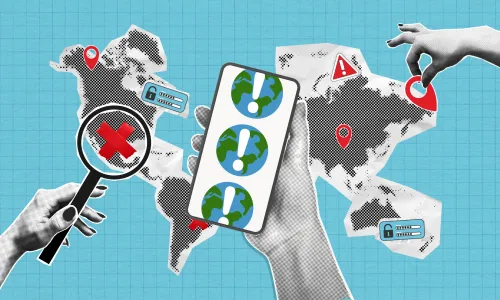
The global internet is turning into a maze of speech laws — and some of those laws are starting to reach into the United States. How do we protect free expression online without letting Americans’ First Amendment rights get chipped away in the process?
Across countries and regulatory bodies, we’re watching a patchwork of rules emerge that are convoluted, overlapping, and often flatly contradictory — with some of them openly censorial. Far more than with traditional media, regulation of the Internet and social media has the potential to bleed across borders. What happens when a provider or user physically in the United States faces a foreign statute or court order penalizing speech well within the First Amendment’s protection?
Freedom of expression is a human right, not just an American right. Nevertheless, sovereign nations have the authority to legislate within their borders, and often do so in ways that are deeply detrimental to the free exchange of ideas. Take the UK’s utterly disastrous Online Safety Act rollout, Brazil’s threat to fine virtual private network (VPN) users who accessed X, and then-European Commissioner Thierry Breton’s warning to Elon Musk for planning to stream an interview with then-candidate Donald Trump, for example. These nations do not, however, have the authority to impose these regulations beyond their borders to dictate what residents of other nations can say, write, or see — or to expect other nations to facilitate extraterritorial censorship.
To be sure, foreign governments and officials are not the only Internet censors. At the time of this writing, American actors are seeking censorship abroad, too. For one example, the administration’s proposal that foreign tourists will have to provide five years of social media history to enter the United States sends an ominous, un-American message to the entire world: If you wish to visit American shores, you must self-censor at home. And Congress, as well as legislative bodies nationwide, have proposed, considered, and even enacted laws that would lead to the same kinds of online censorship our government has criticized foreign governments for engaging in.[1]
The U.S. must exemplify the golden rule of free expression: Give the same respect to speech rights overseas that we want shown to Americans abroad.
FIRE believes freedom of expression is a human right. To best protect that freedom online, both here in the United States and abroad, FIRE encourages key stakeholders to embrace these principles.
Tech companies and social media platforms should make decisions that recognize free expression as a value worth preserving on the global internet. As FIRE has said before, platforms possess their own right to determine content moderation rules — and they should honor them transparently and consistently. If a platform promises it will protect free expression, it should stand by that commitment. And here’s the truth: Sometimes values can be costly. It can cost money — perhaps a lot — in current and future revenue to fight a foreign power’s takedown demand or decide that access to certain markets may not be worth the compliance it requires.
So corporate leaders who have committed to free expression should ask themselves: Have we stood by those values?
Make no mistake: It requires time and money, but it is possible for corporations to fight back. When they fight and win, they help advance the promise of what technology can mean for the future of free expression. Resisting demands to restrict information can help convince foreign states that censorship is futile — or that it will backfire. Wikipedia did not comply with the Pakistan Telecommunication Authority’s demand that it remove “blasphemous” material, leading to a block within the country in 2023. But just days later the ban was lifted, with Prime Minister Shehbaz Sharif admitting the “unintended consequences of this blanket ban . . . outweigh its benefits.” Similarly, in 2020, Wikipedia successfully sought the end of a nearly three year ban after challenging the censorship in Turkey’s Constitutional Court. Other challenges, like X’s battles in India or Wikipedia’s opposition to the UK Online Safety Act’s Categorisation Regulations, have been less successful. But they are still battles worth fighting.

Spain considers banning teens from social media and holding tech executives criminally responsible for ‘hate speech’
Spain eyes jailing tech CEOs and banning teens from social media as global crackdowns on speech grow — from Hong Kong to Pakistan and the UK.
Companies should also resist giving censorship orders or policies they follow abroad against their own editorial judgment effect beyond the borders of the jurisdiction(s) in which they are applicable. If a company is forced to comply with an order originating in the UK, the EU, Turkey, India, or Brazil, that compliance should be limited to the originating country. The rules on the global internet cannot devolve to those dictated by the most authoritarian denominator. It would be a gift to authoritarians everywhere to cede any further ground to them beyond that over which they already exert censorial authority. Speech, ideas, and communication — not censorship — are what should transcend borders.
And last, but certainly not least, companies should not comply with unconstitutional orders or jawboning efforts by government officials in the United States. “Just following the law” is a rationale sometimes used by corporations that unquestioningly abide by censorship demands overseas, but in the U.S. the Constitution is the supreme law of the land. Government demands that conflict with the First Amendment are themselves unlawful. As the Supreme Court recently cautioned, “[o]n the spectrum of dangers to free expression, there are few greater than allowing the government to change the speech of private actors in order to achieve its own conception of speech nirvana.” Rather than taking the path of least resistance, companies should stand up for their own rights, and the rights of their users.
Internet service providers, cloud hosting, or web hosting services operating and based in the United States should not acquiesce to demands from overseas officials or entities to extraterritorially take down sites for speech protected by the First Amendment in the U.S. Hosting services must reject threats like Chinese tech conglomerate Tencent’s alleged abuse of trademark claims to pressure American cloud computing company Vultr to take down Chinese censorship watchdog FreeWeChat. Services must firmly reject censorship demands untethered to legitimate trademark or other infringement claims. It’s especially important that infrastructure services providing the backbone of the internet show some spine. When social media platforms face pressure to take down material, it often results in censorship of individual posts or users. If hosting and backbone services do not stand strong, however, they will give censors veto power over a much broader range of content and speakers in a single swipe — and give any country’s censors power over what netizens worldwide can see. The globalized effect of infrastructure-level internet censorship is what led Cloudfare, a network provider based in the United States with global operations, to refuse an Italian authority’s site-blocking demands.
Foreign governments, international organizations, and regulatory bodies should take a free expression-first approach when devising or advocating for regulations governing social media and the companies that operate it. The United Nations, the European Union, and foreign nations around the world are not bound by the First Amendment and indeed may be bound by treaties or policies that explicitly disallow adopting the speech-protective standards Americans enjoy. But foreign governments must, at minimum, avoid pursuing regulations that would require or enable the use of American courts to violate First Amendment rights.
Other nations and regulatory bodies are unlikely to ensure those protections of their own volition, though. So here at home, American officials should recognize the reality that the best chance for a lasting solution may be a political one and lead a diplomatic effort with allies to pursue treaties that ensure protections for online speech. At minimum, American officials should seek allies’ agreement to forswear efforts to enforce foreign speech restrictions against American platforms and speakers within American borders. U.S. courts and officials must not — and cannot — participate in or enforce foreign laws that would violate the First Amendment.
American legislators and government officials must remember that, despite the shifting global regulatory landscape, the First Amendment is non-negotiable. For Americans’ pleas for greater collaboration to protect free speech to be taken seriously, we must uphold expressive rights here at home. Don’t be tempted to follow censorship playbooks from abroad, whether from China or Australia. These are lessons the United States should have followed, for example, in the TikTok saga. If a policy you propose or for which you advocate is one you would complain about (or have complained about) if a foreign jurisdiction attempted to impose it on U.S. citizens, or if it treats the First Amendment as a barrier or impediment to the policy’s goals, abandon the policy. Calls to regulate online speech routinely invoke concerns like child safety, misinformation, and national security to justify urgent action. None of these concerns, however, no matter how pressing, validate the erosion of Americans’ speech rights, online or off.
Legislators should also ensure the United States does not assist in “takedown tourism,” the enforcement of foreign judgments or penalties against an American speaker if it would violate the speaker’s rights here. In crafting legislation, drafters should look to the U.S. District Court for the Northern District of California’s reasoning in Yahoo! v. LICRA, where it prohibited enforcement of a French order punishing Yahoo! for the sale of material lawful in the U.S. but illegal under French law, holding that were such enforcement allowed, “the threat to … constitutional rights is real and immediate.” While the decision was ultimately reversed on procedural grounds, its substantive reasoning remains sound and instructive — and other courts have similarly enjoined domestic enforcement of foreign censorship orders.
Our Principled Record
In our two decades of First Amendment advocacy, we have zealously worked on behalf of individuals from a broad swath of American society who are representative of our nation’s remarkable social, political, religious, and cultural diversity.
Foreign courts and regulatory bodies may have the authority to levy penalties against American companies’ assets in those nations for failure to censor or comply. And they may accordingly draft laws compelling companies to retain assets and employees to remain accessible in the foreign jurisdiction. But U.S. courts cannot become their middle man for censorship. We have recognized similar problems in the past in the case of libel tourism, leading to passage of the vital SPEECH Act, which ensures foreign actors cannot enforce censorial libel judgments in U.S. courts. As FIRE’s President and CEO Greg Lukianoff advised in The Washington Post, “Congress should pass new laws that protect Americans from foreign censorship, so international speech penalties and censorship demands don’t become backdoor restraints on Americans’ freedom of speech.” Lawmakers are exploring responses at the state level, too. For example, legislators in Wyoming recently introduced a bill prohibiting state actors and courts from cooperating with or enforcing foreign actions against state residents’ speech.
And, finally, legislators and government actors in the U.S. cannot attempt to export censorship abroad or seek to limit overseas speech they cannot legally silence here. The U.S. must exemplify the golden rule of free expression: Give the same respect to speech rights overseas that we want shown to Americans abroad. If we want other nations to acknowledge our rights, we must do the same for those nations and their citizens.
Users should know their rights and understand their options when it comes to their ability to speak online. Beyond standard appeal processes voluntarily provided by most platforms, users may have little recourse for account or content removal by social media platforms, which — as we have noted — have their own right to moderate content as they see fit. But because a company can restrict speech does not mean it should. If users believe their speech did not violate terms of service but was nevertheless removed or blocked — especially via overcompliance with foreign legal demands — they should advocate for the platforms they use to adopt more speech-protective policies.
Free speech is a vital human right. Preserving expressive rights online for everyone — not just those of us lucky enough to live in nations committed to free expression, but rather across our planet — is necessary to realize the internet’s continued potential as a technology of freedom.
[1] While a full account of our advocacy on this front is beyond this statement’s scope, FIRE’s work holding our own government to account continues.