Table of Contents
Our ancient faith in liberty
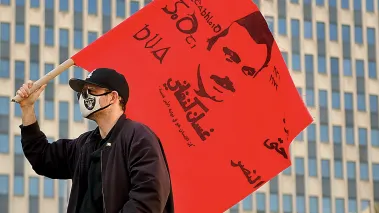
Protests in Thomas Paine Park against the detention of Palestinian activist and Columbia student Mahmoud Khalil on March 10, 2025.
In the summer of 1798, Congress gave the president the power to expel any foreigner he personally judged dangerous. Though the president never used the Alien Friends Act, and it expired two years later, it had its intended result. French printers, teachers, and booksellers sold their belongings and took ship out of Philadelphia, rather than wait to find out if the president had them in mind. Thomas Jefferson later argued that to put such power in the hands of one person is the very definition of despotism.
Last Friday, a federal court in California reminded us of this in Stanford Daily v. Rubio, in which Judge Noël Wise held the government cannot deport people for their opinions. The court held that the two provisions of the Immigration and Nationality Act that Secretary of State Marco Rubio invokes in trying to do so violate the First Amendment and the Fifth Amendment when used to target protected speech. The first provision FIRE challenged lets the secretary of state cancel anyone’s visa, at any time, for any reason. The second lets him deport anyone over protected speech so long as he “personally determines” the speech “compromises a compelling United States foreign policy interest.”
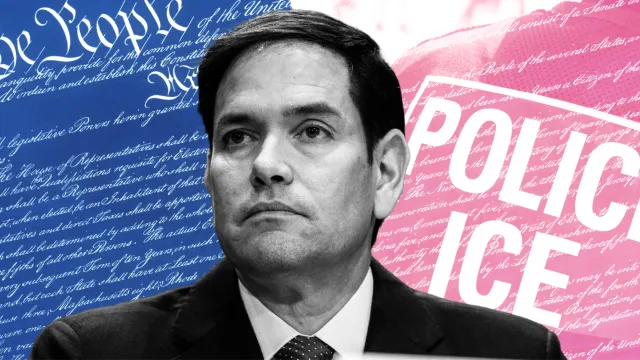
Federal court rules the statutes the Trump admin used in its speech-based deportation scheme are unconstitutional
A federal court ruled that the provisions Secretary of State Marco Rubio used in an attempt to deport legal immigrants for their speech are unconstitutional.
After the Trump administration began targeting people for pro-Palestinian speech, The Stanford Daily saw multiple staff reporters and editors refuse to cover the war in Gaza out of fear of being deported. Some even quit the paper rather than take the risk of doing journalism in such a climate. Their fear was not without reason. The government had already arrested and detained for deportation multiple people for daring to voice their opinions on one of the most widely discussed issues in recent history.
Rümeysa Öztürk, a doctoral student studying the positive uses of social media by adolescents, became deeply troubled by what she read about the war in Gaza, so she decided to co-author an op-ed in her student paper calling on Tufts University to divest from companies tied to Israel. Mahmoud Khalil, who had studied international relations as a Columbia grad student, took part in pro-Palestinian protests and characterized Palestinian actions as “armed resistance, which is legitimate under international law.” Mohsen Mahdawi, who had been recently accepted into the same program as Khalil, blamed Israel for the Oct. 7 attacks and said he does not justify such violence, but empathizes with Hamas.
These views may offend many who hear them, just as they may gain instant agreement from others. This is how the marketplace of ideas is supposed to work. President Jefferson understood this. He took the oath in 1801, after an election so vicious that Federalists had warned a Jefferson presidency would burn the churches and end the republic itself. His own allies were jailed under the Sedition Act for the crime of criticizing the government. Yet in his wisdom, delivering his inaugural address, he turned to the very people who thought him the enemy of constitutional order and asked that they be left to stand undisturbed, as “monuments of the safety with which error of opinion may be tolerated where reason is left free to combat it.”
When voices fold into silence, we not only lose their unspoken perspective, we lose touch with what it means to be American.
The three students identified above were all pursuing academic study in America and expressing opinions on a widely debated topic. Their right to do this without punishment for stating their views is not only a testament to American freedom, but to the distinctly American tradition of intellectual resilience that does not merely tolerate differences of opinion, but recognizes in them an opportunity, and holds fast to the belief that we can be made better by hearing them, even if we think they’re wrong. Yet for their thoughtcrimes, all three were arrested and nearly removed from the country.
As a result, Stanford Daily reporters on student visas began turning down assignments about the Middle East. Not just opinion pieces, mind you, but reporting work. Now multiply that by every campus paper, every graduate seminar, every noncitizen who has an informed view about a place they actually come from, or simply a different opinion about whatever might be in the news that week. What you end up with is public conversation in America with a conspicuous hole in the middle.
Nor was the Daily alone in the lawsuit. A second plaintiff, participating under a Jane Doe pseudonym, with no connection to the paper or the school, also felt the chill and simply stopped going to protests. She stopped wearing a keffiyeh. She decided it was wiser to surrender the expression of her own beliefs than to risk the wrath of a censorial government. Her story should remind us that censorship is most effective when it need not be enforced, but rather operates on the mind of the victim before an offending idea is ever given voice. And more is lost than just her opinion. When voices fold into silence, we not only lose their unspoken perspective, we lose touch with what it means to be American, and lose our grip on the very promise of our republic.
We are a country made great in no small measure by more than two centuries of welcoming brilliant minds from abroad. Add to this that there was once something deeply American about taking pride in saying the unpopular thing, and saying it loud. Now we find ourselves telling visitors that they had better watch what they say, or simply keep their thoughts to themselves, lest they bruise our fragile sensibilities and lose their right to remain in the country.
Thankfully, last week’s ruling places the First Amendment back at the forefront. Meanwhile, Khalil’s and Mahdawi’s cases are still working their way through the system. But we are at least now turning in the right direction. A noble principle, once commonly held, is coming back into view. As Judge Wise said in her ruling, “You can simultaneously hate the content of a person’s speech and love the country that cherishes the freedom to allow it.”
Recent Articles
Get the latest free speech news and analysis from FIRE.
VICTORY: New Jersey drops complaint against school board member targeted for asking constituents about taxes
FIRE sues Los Angeles City Council over policy banning certain words during public comment

It was never just going to be about keeping kids off social media