Table of Contents
Nebraska school district censors anti-ICE cartoon, forces prior approval on student press
Licensed under CC BY 4.0.
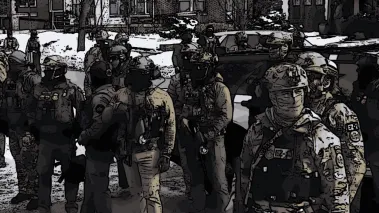
ICE agents in Portland, Oregon, on Jan. 7, 2026, after the killing of Renée Good. Color adjusted.
A Nebraska school district censored a student newspaper over an anti-ICE cartoon. After FIRE objected, the district adopted a new policy that gives administrators formal power to restrict student journalism before publication.
The cartoon, made by Aidan McClaren, was the first and only editorial cartoon for Gretna East High School’s student newspaper last school year. That original cartoon now sits in a storage bin alongside his academic decathlon trophies and journalism awards, after it was scrubbed from the school paper’s website.
McClaren was not originally a cartoonist. But when The Wingspan’s editor-in-chief noted that the paper hadn’t published any cartoons that year, McClaren, then a junior, started thinking. Later, when he got home from his after-school job, the day’s news was top of mind: ICE’s presence in Minneapolis, Renee Good, Alex Pretti.
That night, he drew. “I knew I wanted to reference how it was similar to things that I had learned about in my history class that I took my sophomore year,” McClaren said in a video call interview. His idea quickly took shape. The finished cartoon showed a young man looking at a factory labeled “History” with gears denoted as "Bureaucracy" and “Loopholes” churning out historical actions such as the Palmer Raids and Japanese internment alongside ICE.
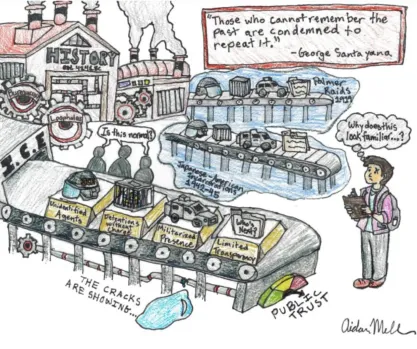
“It took me a full week to muster up courage and show it to my class,” he said. After student leaders signed and approved, the cartoon found its home on The Wingspan’s website on Feb. 10. But it didn’t stay there for long.
Shutting down ICE criticism
McClaren was at home on his couch watching a reality TV show with his mom when his phone buzzed around 9 p.m. on Feb. 12. It was his student newspaper adviser. Two days after The Wingspan published McClaren’s cartoon, school administrators had taken it off the website.
“I was immediately kind of angry,” McClaren said. But McClaren didn’t just let it fester or stun him into inaction. He wrote another piece for The Wingspan — this time, an op-ed about his experience being censored.
“When our publication displayed a cartoon comparing ICE operations to past American military operations, the district administration had it removed,” he wrote. “The justification offered was that the topic was too controversial at the moment, and that people in our community were dealing with it firsthand. By that standard, no editorial cartoon worth publishing would ever see print. That is not a reason to suppress a cartoon. That is a reason to publish one. The district disagrees.”
The school blocked the piece’s publication, too.
Administrators gave McClaren and The Wingspan a choice: they could republish McClaren’s cartoon in the paper if the paper also published a pro-ICE cartoon or if they explained the cartoon for their audience. Otherwise, the pieces would stay offline.
McClaren wasn’t alone in feeling the school’s actions were wrong. Fellow Wingspan journalist Nick Mitchell launched a petition. Editor-in-chief Madeline Petrick asked the school to provide the reasons for the censorship in writing. The students attended a school board meeting on March 30 to ask the Gretna Public Schools Board of Education to adopt a student press freedom policy, reinstate the cartoon, and stop conducting prior reviews.
Skirting around student speech standards
FIRE wrote to the school shortly after, echoing McClaren and his fellow student journalists’ calls and explaining the constitutional defects of the district’s actions and subsequent responses to the students.
Administrators pointed to the Supreme Court cases Hazelwood v. Kuhlmeier and Tinker v. Des Moines, reasoning they permitted the takedown and subsequent demands for prior review. While it’s true that school officials have greater authority to regulate student speech than the government ordinarily has with respect to the public, that authority comes with important safeguards. Public school students “do not shed their constitutional rights to freedom of speech or expression at the schoolhouse gate,” as the Court said in Tinker.
Tinker permits school officials to regulate student expression when they reasonably forecast that it will substantially disrupt school activities or invade the rights of others. Officials must support that conclusion with actual evidence, not just unsubstantiated fear. Gretna Public Schools offered no more than McClaren’s cartoon itself, which they posited could lead to a substantial disruption. Under Tinker, which doesn’t allow schools to merely rely upon “undifferentiated fear or apprehension of disturbance,” that reasoning fell flat.
The school also pointed to Hazelwood, but that standard did not seem to apply to The Wingspan. Hazelwood grants a more deferential standard to public school officials when dealing with “school-sponsored speech,” allowing them to regulate speech when their actions are reasonably related to legitimate pedagogical interests.
But based on the publication’s history of editorial independence, that standard would not apply. Hazelwood undeniably gives administrators more discretion over school-sponsored student speech — including student newspapers that are produced as part of a class or otherwise not set aside “by policy or practice” as forums for independent expression. But as McClaren and his peers noted, The Wingspan had long operated as such a forum. The school only took issue when his anti-ICE cartoon crossed their desktops.
But strong policies cement such protections and make it harder for administrators to deny them. That’s why McClaren, his peers, and FIRE called on the district to promulgate an official student media policy that protected student press rights.
Instead, they passed one that gutted them.
Making prior review permanent
On June 22, the Gretna Public Schools Board adopted an official policy regarding student media. Prior to its passage, McClaren and his peers didn’t have a chance to see what the new rules would be. “They never gave us a copy of the policy to read,” he said. It wasn’t until the policy had passed that McClaren and his peers could review it.
The policy marks a stark change. Student media is now considered “school-sponsored or part of the curriculum” that shall be “under the supervision and control” of not only the adviser but also the “building principal or designee.”
And while McClaren and his peers had largely operated without prior review in the past, the new policy allows for pre-publication review. “Prior to publication or distribution, school-sponsored student media may be reviewed by the classroom instructor, sponsor, principal, or designee to determine whether material is appropriate for publication or dissemination in a school-sponsored forum.” Among material that administrators may withhold is content that “gives the appearance of endorsing a political candidate or pending ballot issue.”
How the district treated McClaren’s cartoon offers little reason to believe it will limit the authority it granted itself to legitimate pedagogical concerns. McClaren connected the cartoon and the school’s reaction to it with the updated language. “You pretty much take a side in an opinion,” he noted. “And so, if [that opinion] were something political, then that would be pretty much in violation of that ninth bullet on there.”
McClaren said he sent emails to the superintendent and school board but didn’t hear back. But he wasn’t fazed. Instead, McClaren decided to look for other options to make change.
This Michigan city threatened critics over ‘cyberbullying.’ Now it’s hiding the evidence.
When government officials threaten to sue and prosecute their constituents over speech, the public should get to see the evidence.
He began advocating for New Voices legislation. “I switched my focus so that the law would say they have to change.” He attended the New Voices Student Leaders Institute led by the Student Press Law Center, learning alongside other high school student journalists how to advocate for state-level protection for the student press.
These bills are designed to reverse the effects of Hazelwood, and often include language to stop Hazelwood from being improperly applied on college campuses. These statutory protections generally ensure student media remains free from administrative control or prior review.
“That’s my workaround to make them change it,” McClaren said of the school board and its new student media policy.
But for now, the district-level policy is in place, allowing prior review and placing restrictions on political content. Welcome back to school, Gretna East High student journalists. You have less press freedom now than when you left.
Recent Articles
Get the latest free speech news and analysis from FIRE.

Why you should talk to strangers w/ Fin Colleton and Kratima Divakar
Podcast
After a congressman challenged a student reporter’s right to record, here’s what journalists should know
Restoring Title IX kangaroo courts is no solution to the ‘Cornell 7’ sexual assault controversy