Table of Contents
Enacted Campus Free Speech Statutes – Oklahoma
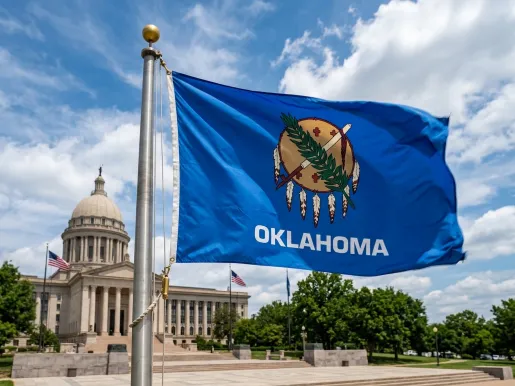
In 2019, Oklahoma enacted SB 361, now Okla. Stat. Ann. tit. 70, § 2120. In 2022, Oklahoma enacted HB 3543, amending Okla Stat. Ann. tit. 70 § 2120 and adding Okla. Stat. Ann. tit. 70, § 3205.11 through 3205.14 In 2026, Oklahoma enacted SB 1725, amending Okla. Stat. Ann. tit. 70, §§ 2120 and 3205.14.
SB 361 Summary
SB 361 is a campus free speech bill that prohibits institutions from quarantining student speech to misleadingly labeled “free speech zones,” and adopts the United States Supreme Court definition of harassment.
Key Provisions
- Defines student-on-student harassment consistent with the United States Supreme Court standard in Davis v. Monroe County Board of Education;
- Declares that the outdoor areas of campuses are public forums for the campus community and prevents institutions from creating “free speech zones”;
- Requires institutions to inform students of free speech regulations and expectations during orientation programs;
- Mandates colleges and universities publish an annual report to the governor and legislature describing any barriers to or incidents of disruption of free expression occurring on campus; and
- Provides a cause of action for students and student organizations if rights provided by the bill are violated by an employee of a public college or university.
HB 3543 Summary
HB 3543 is a campus free speech bill that establishes the Oklahoma Free Speech Committee to the Oklahoma State Regents for Higher Education. This committee is charged with monitoring free expression policies at Oklahoma’s public institutions of higher education.
Key Provisions
- Establishes the Oklahoma Free Speech Committee to the Oklahoma State Regents for Higher Education;
- Instructs the Oklahoma Free Speech Committee to review the free speech policies of Oklahoma public universities;
- Requires public colleges and universities to publish contact information on their websites for reporting free speech concerns to the Oklahoma Free Speech Committee and directs the committee itself to “develop a process of collecting complaints of free speech violations on public university campuses and advise complainants of their rights”;
- Orders institutions to send their annual reports on free speech barriers to the Chancellor of the Oklahoma State System of Higher Education; and
- Directs the Oklahoma Free Speech Committee to “either develop a First Amendment training or approve of an outside First Amendment training that shall be required for all college deans, heads of departments, and individuals responsible for establishing university free speech policies or handling free speech complaints.”
FIRE Commentary
Oklahoma forms Free Speech Committee to guard against campus censorship
SB 1725 Summary
SB 1725 supplements and clarifies Oklahoma’s campus free speech law..
Key Provisions
- Prohibits “security fees” for expressive events that are content-discriminatory or based on the anticipated reaction to the event, and requires that any security fees be administered through a published, content- and viewpoint-neutral policy;
- Clarifies that an institution may only discipline a student’s expression as harassment if it satisfies the United States Supreme Court standard in Davis v. Monroe County Board of Education;
- Orders institutions to send their annual reports on free speech barriers to the Oklahoma Free Speech Committee;
- Directs the Oklahoma Free Speech Committee to develop a mandatory free speech training to be completed by all students within their first year of enrollment at an Oklahoma institute of higher education, which must, among other things:
- Explain that outdoor areas of campus are public forums for members of the campus community;
- Explain the university’s content- and viewpoint-neutral time, place, and manner restrictions on expressive activities;
- Explain that freedom of expression does not permit disrupting another person’s expression in a space reserved for that expression;
- Encourage students to respond to speech they disagree with by making counterarguments and explain that the institution will not intervene against protected expression that complies with time, place, and manner rules; and
- Explain the process for filing a lawsuit or complaint to the Oklahoma Free Speech Committee.